

AI agents are rapidly evolving from stateless chatbots into persistent digital collaborators that remember, adapt, and learn over time. A key driver of this shift is cross-session memory: the ability for an agent to retain information and experiences across separate interactions, days or even months apart. Instead of treating each conversation as a blank slate, modern agents can build a long-term model of users, tasks, and environments.
Over the past year, research prototypes and cloud platforms alike have introduced memory-centric architectures designed specifically for long-lived agents. Academic frameworks such as Mem0, MemInsight, Memoria, and WebCoach show how structured, persistent memory improves reasoning, personalization, and efficiency in complex tasks, while industry offerings from AWS, Google, and specialist startups are turning these concepts into production-ready services. Together, they mark a decisive step toward agents that truly evolve with experience rather than simply performing pattern matching within a single context window.
From stateless chatbots to agents with persistent context
Traditional large language model (LLM) interfaces are fundamentally stateless: once a session ends, the model forgets everything unless developers manually replay the entire history. This design limits agents to short-lived tasks and forces users to constantly reintroduce preferences and background information. It also prevents agents from learning across interactions, since there is no canonical place where experiences are stored, curated, and reused later.
Cross-session memory directly attacks this limitation by introducing durable storage that outlives any individual conversation. Instead of relying solely on the model’s context window, the agent is supported by an external memory layer that can store summaries of past sessions, extracted facts, user preferences, and task trajectories. Systems like Mem0 and MemInsight show that when agents can retrieve semantically relevant snippets from these stores, they answer more accurately and reason over longer time horizons than purely stateless baselines.
Cloud providers are now standardizing this pattern. Amazon Bedrock’s AgentCore Memory, introduced in 2025, provides built‑in support for both short-term session memory and cross-session persistence keyed by user identifiers, so the same agent can remember preferences, previous questions, and resolved issues whenever a user returns. Google’s Vertex AI Memory Bank similarly offers persistent context for agents built on its Agent Engine, allowing them to maintain continuity and personalization without bespoke infrastructure. These services indicate that cross-session memory is becoming a first‑class primitive for production AI agents, not a niche add‑on.
Architectural patterns for cross-session memory
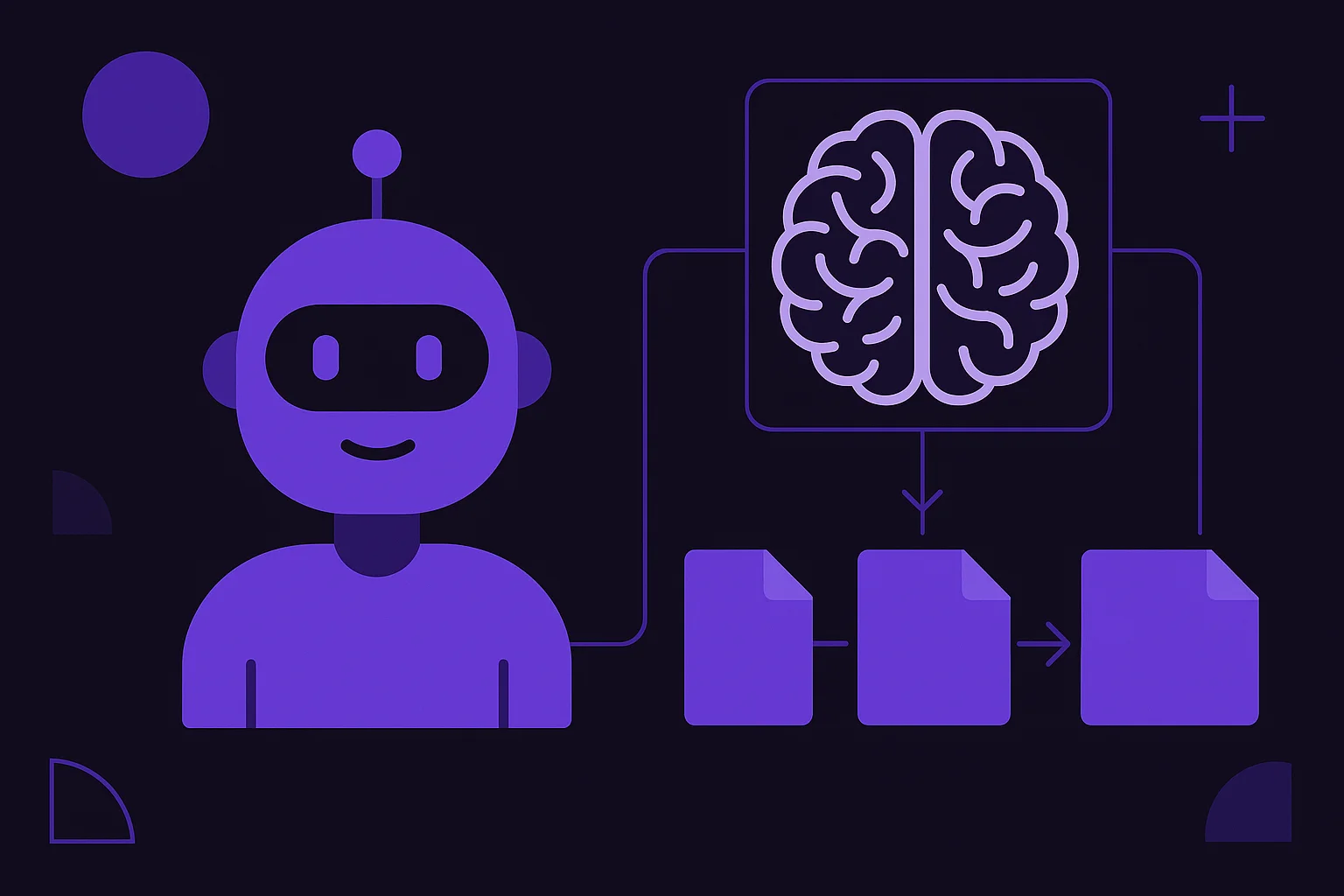
Modern cross-session memory systems typically follow a layered architecture that separates raw logs, condensed summaries, and structured knowledge. At the base, agents record interaction histories, tool calls, and environment observations. Because storing and replaying full logs is expensive and often noisy, a summarization or condensation stage converts them into compact, semantically meaningful representations. WebCoach, for example, introduces a “WebCondenser” that turns detailed web browsing traces into standardized episodic summaries that are easier to store, search, and reuse.
On top of condensed episodes, some frameworks build structured semantic layers to represent more durable knowledge. Mem0 and Memoria both explore graph-based or knowledge graph style memory, where entities like users, projects, and resources are linked by typed relationships. This structure helps agents answer multi-hop and temporal questions, since they can traverse relationships instead of scanning unstructured text. It also supports targeted updates: when a user changes preference or a fact becomes outdated, specific graph nodes can be updated without rewriting the entire memory store.
The final layer is intelligent retrieval and control. When a new task begins, the agent or a dedicated “coach” process decides which memories are relevant, often using vector search over embeddings combined with recency and importance scores. WebCoach’s Coach component, for instance, retrieves related past trajectories and injects them as advice into the agent at runtime, enabling the agent to avoid repeating past mistakes. Industry platforms like SmartMemory and Bedrock AgentCore Memory similarly emphasize selective retrieval, ensuring that only the most pertinent past insights are surfaced, both to control token costs and to avoid overwhelming the agent with irrelevant history.
How agents evolve by learning across sessions
Cross-session memory is not just about remembering facts; it is about enabling agents to evolve. Each interaction becomes an episode from which the system can derive new skills, updated heuristics, or refined user models. Over time, these episodes accumulate into a rich experiential knowledge base, making the agent more robust and better aligned with its environment. WebCoach, for example, shows that web browsing agents with episodic memory learn to avoid repetitive navigation errors and plan more efficiently on benchmarks like WebVoyager, achieving higher success rates with fewer steps than agents that do not learn from past runs.
Academic work such as MemInsight emphasizes autonomous memory augmentation, where agents themselves decide what to store and how to refine past data to make it more useful for future tasks. In conversational recommendation or research scenarios, this means not only logging dialogue, but also extracting persistent preferences, recurring goals, and stable beliefs that shape subsequent recommendations. As memory grows, agents develop richer priors about users and domains, leading to more coherent long-term behavior.
Commercial implementations adopt similar ideas. Services like SmartMemory and multi-session memory tutorials from cloud providers highlight patterns where agents maintain user-centric histories, track unresolved tasks, and log error patterns. When users reappear, agents can resume open threads, acknowledge past issues, and proactively correct behaviors that previously caused friction. This continual refinement is a practical form of self‑evolution: without retraining the underlying model, the agent’s effective behavior improves because its memory-guided policy becomes more informed and context-aware.
Personalization and user modeling with agentic memory
One of the most compelling motivations for cross-session memory is deep personalization. Rather than asking users to repeat their preferred tone, formats, or domain-specific constraints in every session, memory-augmented agents can store and refine persistent profiles. Frameworks like Memoria explicitly model user traits and preferences in weighted knowledge graphs, capturing not only static facts (such as favorite tools or languages) but also behavioral patterns such as how often a user revisits a project or how they respond to certain recommendations.
Industry platforms echo this focus on long-term user modeling. Magicdoor’s memory system, for instance, advertises universal, cross-chat persistence: the same memory store is accessible across different models and sessions, allowing the assistant to remember communication style, recurring tasks, and ongoing projects no matter which underlying LLM is used. Similarly, Bedrock’s AgentCore Memory is designed to bind long-term memory to stable user identifiers, making it straightforward for an organization to deliver consistent experiences across channels and devices.
These capabilities transform how users interact with AI agents. In research and knowledge work, memory-augmented assistants can recall past hypotheses, documents, and decisions, supporting iterative exploration rather than one-off question answering. In customer support, agents can track a user’s history of issues, preferences, and resolutions, leading to more empathetic, efficient interactions. Over time, the agent’s understanding of each user evolves from shallow metadata to a nuanced, multi-dimensional profile, enabling experiences that feel closer to working with a long‑term human collaborator.
Infrastructure and tooling: memory as a managed service
As cross-session memory becomes mainstream, developers increasingly rely on managed infrastructure rather than ad hoc implementations. Amazon’s Bedrock AgentCore Memory and Google’s Vertex AI Memory Bank are clear examples: both offer memory management as a cloud service, abstracting away data storage, indexing, and retrieval, while still allowing developers to specify what should be remembered and for how long. These services integrate directly with their respective agent runtimes, enabling declarative configuration of memory scopes and policies.
Independent providers are also emerging with specialized offerings that treat memory as a universal layer for heterogeneous agents. SmartMemory markets itself as a “Plaid for agent memory,” aiming to provide a secure, model-agnostic API that any agent framework can plug into. Other platforms demonstrate integrated tutorials where cross-session memory is tested by simulating returning users: an AI assistant recognizes a user’s previous orders or conversations even when a new session is initiated, validating that persistent memory is correctly wired into session and user identifiers.
This ecosystem of tools lowers the barrier for organizations that want to experiment with evolving agents without building entire memory stacks from scratch. By combining vector databases, knowledge graphs, and LLM-based summarization under the hood, these platforms offer opinionated best practices for scalable, low-latency memory workflows. Developers can focus on higher-level questions, what should the agent learn and how should it act on that learning, while delegating storage formats, retrieval tuning, and infrastructure operations to specialized services.
Design challenges: forgetting, safety, and evaluation
Despite the promise of cross-session memory, designing agents that evolve safely and effectively remains challenging. One concern is “over-remembering”: storing too much detail about users or conversations can increase latency, clutter retrieval results, and pose privacy risks. Systems like Mem0 and MemInsight tackle this by focusing on selective extraction of salient information and by periodically consolidating memories into higher‑level summaries, reducing redundancy while preserving useful signal. Managed services similarly offer controls to limit what categories of data are stored and for how long.
Another challenge is controlled forgetting and correction. If an agent has stored outdated or incorrect information, it must be able to update or discard those memories to avoid perpetuating errors. Structured memory architectures, including knowledge-graph-based systems like Memoria, make this easier by representing knowledge as editable nodes and edges. Developers can design policies for conflict resolution, versioning, and decay, ensuring that the agent’s evolving beliefs track the current reality rather than fossilizing early assumptions.
Evaluation is also non‑trivial. Standard benchmarks for LLMs often focus on single-turn or single-session tasks, whereas cross-session memory requires measuring performance across longer time scales and varied scenarios. Recent research introduces benchmarks emphasizing temporal reasoning, multi-hop retrieval across sessions, and long-term user satisfaction. Mem0, for example, reports improvements in LLM-as-a-judge metrics and substantial reductions in latency and token cost compared to naïve full-history approaches, providing evidence that well-designed memory yields both quality and efficiency gains. As more agents deploy persistent memory in the wild, real-world telemetry, task success over weeks, retention, and user trust, will become increasingly important metrics.
Use cases where agents evolving with memory matter most
Not every application needs a deeply evolving agent, but certain domains benefit disproportionately from cross-session memory. Research assistants are a prime example: deep research often unfolds over weeks or months, requiring synthesis of papers, notes, and experiments across many sessions. Memory-augmented assistants can track evolving hypotheses, summarize prior findings, and highlight inconsistencies or gaps, behaving more like an ongoing collaborator than a query interface.
Customer-facing agents in support, sales, and onboarding also gain tremendous value. With persistent memory, they can recognize returning users, recall previous problems, and adjust tone and complexity based on observed preferences. Tutorials and case studies from cloud providers show how agents with long-term memory can immediately respond to questions about past orders or tickets without asking users to restate context, improving satisfaction and reducing handle time.
Enterprise automation and multi-agent systems are another frontier. Platforms that support shared memory pools allow multiple specialized agents to collaborate over a common knowledge base, coordinating long-running workflows such as compliance monitoring, infrastructure management, or product development. Agentic memory documentation describes architectures where ingestion agents continuously update a persistent store from communication channels and tools, while task-specific agents draw on that shared context to make better decisions. Over time, the organization’s fleet of agents evolves collectively as experiences accumulate in shared memory.
As cross-session memory becomes a standard component of AI systems, agents are beginning to look less like disposable chat windows and more like long-lived digital partners. Research frameworks such as Mem0, MemInsight, Memoria, and WebCoach demonstrate that carefully designed memory, combining episodic logs, semantic summaries, and structured knowledge, can significantly boost reasoning, personalization, and efficiency. Cloud and startup ecosystems are rapidly operationalizing these ideas with memory services that make it straightforward to wire persistent context into production agents.
The next phase of this evolution will hinge on responsible design: deciding what agents should remember, how they should forget, and how their learning over time should be evaluated and governed. When done well, cross-session memory enables agents that grow with their users and organizations, providing continuity, insight, and collaboration that improve with every interaction. Rather than starting from zero in each session, these agents carry forward a living, curated memory, turning experience itself into a core capability.