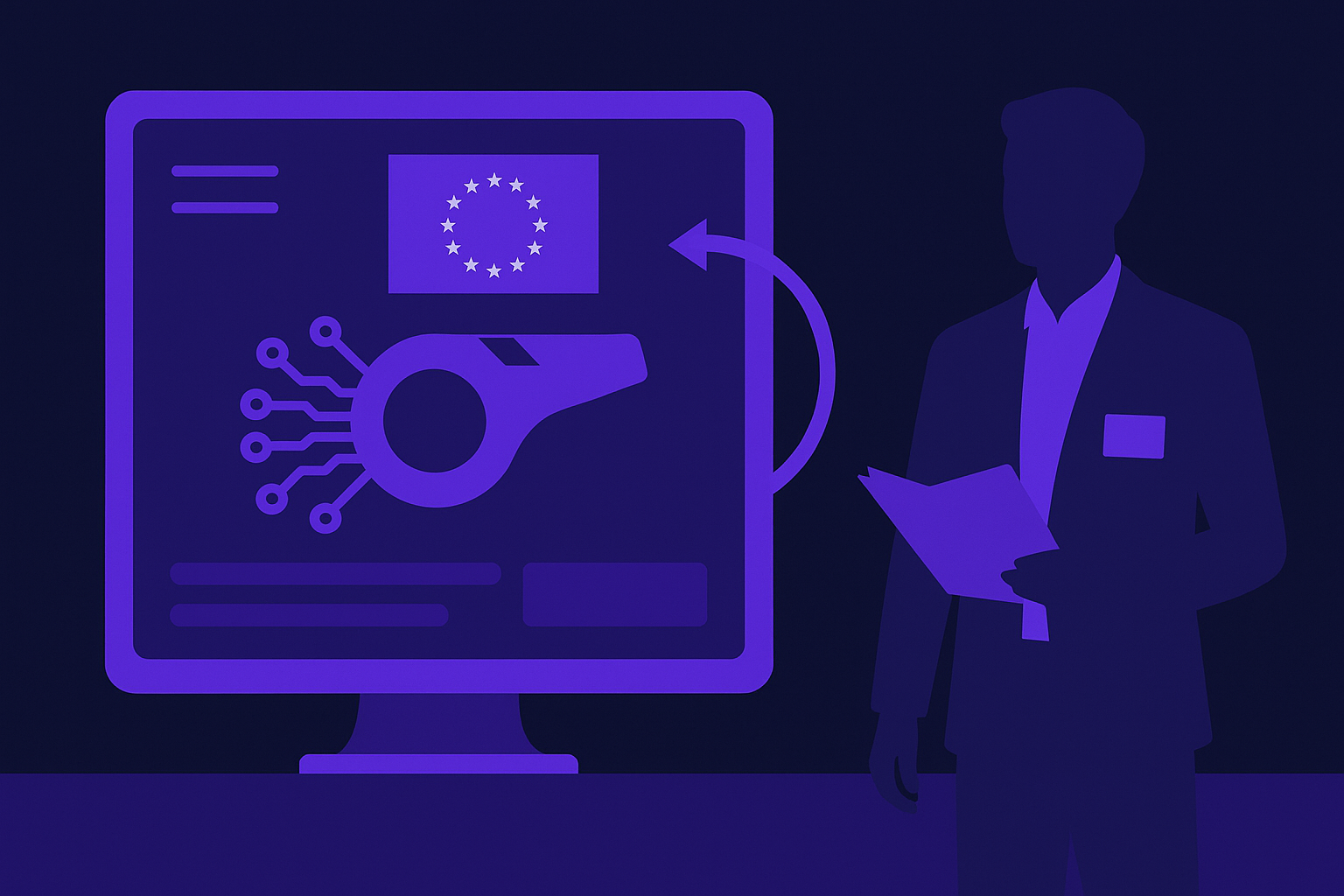
The European Commission has opened a new reporting channel under the EU AI Act: a dedicated whistleblower portal that routes information directly to the European AI Office. Announced on 24 November 2025, the tool is designed to help surface suspected breaches of the AI Act through a secure, confidential process.
In its framing, this is not just a compliance mailbox. The Commission positions the portal as a way to flag potential violations that could endanger fundamental rights, health, or public trust, areas where AI failures and misuse can have immediate real-world consequences.
1) What the EU just launched and why it matters
On 24 November 2025, the European Commission announced the launch of an AI Act whistleblower tool, describing it as “a secure and confidential channel for individuals to report suspected breaches of the AI Act directly to the EU AI Office.” This marks a concrete operational step in turning the AI Act from a legal text into an enforceable regime with intake, triage, and follow-up capacity.
The goal is to lower the friction for insiders and affected professionals to alert regulators when they see risky or unlawful AI practices. In practice, whistleblower information can complement audits, market surveillance, and formal investigations, especially in fast-moving deployments where public regulators may not see problems until harm has already occurred.
Media outlets quickly amplified the announcement. Anadolu Agency summarized the Commission’s key points, including the confidentiality claims and the ability to follow up without compromising anonymity, while Italy’s ANSA echoed the Commission’s message that “certified encryption mechanisms will ensure the highest level of data confidentiality and protection.”
2) Who can use the portal and what can be reported
According to the Commission’s policy page for the AI Act Whistleblower Tool, the portal is aimed at people with a professional connection to an AI model provider. That scope matters: regulators are explicitly signaling that those closest to development and deployment, employees, contractors, partners, and other professionally connected individuals, are likely to hold the most actionable evidence.
The same policy framing highlights reporting harmful practices by general-purpose AI (GPAI) model providers as well as certain AI systems covered by the Act. While the tool does not replace the AI Act’s broader enforcement toolbox, it creates a direct channel for credible, technically grounded leads.
Substantively, the Commission’s November 2025 communication frames the reporting purpose around suspected violations “that could endanger fundamental rights, health, or public trust.” This emphasis underscores a prioritization logic: the portal is especially relevant when potential non-compliance could translate into societal harm, discrimination, safety issues, or systemic integrity risks.
3) Confidentiality, encryption, and the promise of anonymity
A core selling point is confidentiality. The Commission states that “The highest level of confidentiality and data protection are guaranteed through certified encryption mechanisms.” For potential whistleblowers, this is meant to address one of the biggest barriers to speaking up: fear of exposure or retaliation.
Importantly, the tool is not positioned as a one-way dropbox. The Commission says the system enables secure follow-up so whistleblowers can receive updates and respond to additional questions “without compromising their anonymity.” That two-way capability can be decisive, because high-quality enforcement often depends on clarifying technical facts, timelines, system versions, and internal decision-making.
The policy page also describes anonymous reporting and a “secure inbox” for submitting supporting documents, while still enabling follow-up communication. This combination, anonymity plus iterative dialogue, aims to produce reports that are both safe for the individual and useful for investigators.
4) Language and evidence: lowering barriers to usable reports
The Commission states that whistleblowers can submit information “in any of the EU official languages, and in any relevant format.” In an EU-wide market with diverse workforces and cross-border AI supply chains, multilingual intake is not a convenience feature; it is an enforcement necessity.
Allowing “any relevant format” signals that the Commission expects the kinds of materials insiders actually have: documents, screenshots, logs, policy drafts, internal communications, testing results, or risk assessments. This is especially valuable in AI contexts, where technical and governance artifacts often provide the strongest evidence of what was known, when it was known, and what safeguards were (or were not) applied.
The approach mirrors earlier Commission practice. In April 2024, the Commission launched whistleblower tools for the Digital Services Act (DSA) and Digital Markets Act (DMA), allowing anonymous (or non-anonymous) submissions in any EU official language and accepting a wide range of materials (such as reports, memos, emails, and data metrics). The AI Act portal follows that established pattern, adapted to AI-specific risks and actors.
5) Where to find it: portal access, FAQs, and official references
The Commission’s announcement includes an official link to the AI Act Whistleblower Tool submission portal, making the channel directly accessible rather than buried behind general contact forms. This matters because whistleblowing is highly sensitive: extra steps, uncertainty, or unclear routing can deter reporting.
On 25 November 2025, the Commission also listed the tool in the AI Act Service Desk under “Resources,” with a dedicated entry pointing to “Access the AI Act Whistleblower Tool” and linking to FAQs. Centralizing access and guidance helps reporters understand what information is helpful, how anonymity works, and what to expect after submission.
Practical explainers have also started to situate the portal in real compliance workflows. A 5 December 2025 overview in Spanish legal/business press (Cinco Días) described the tool as a “canal confidencial y seguro” for AI Act-related reporting and noted that it can coexist with internal reporting channels, an important point for organizations that already operate hotlines or speak-up mechanisms.
6) What this could change for AI governance and corporate compliance
For regulators, the portal can increase the volume and quality of actionable intelligence. AI systems can be opaque externally, and formal audits may be periodic; whistleblower reports can reveal issues earlier, including problems in training data governance, documentation, risk controls, incident handling, or claims made to customers and users.
For companies and model providers, the portal raises the stakes of internal governance. If professionals can report suspected breaches directly to the EU AI Office with strong anonymity protections, organizations may face greater exposure when internal escalation is ignored or when documentation and risk management are weak.
At the same time, the tool can incentivize better internal speak-up cultures. If firms want employees to raise concerns internally first, they may strengthen internal reporting paths, improve non-retaliation safeguards, and ensure AI Act compliance teams can respond credibly, because an external, encrypted alternative now exists.
The EU’s AI Act whistleblower portal signals a shift from “rules on paper” to a more operational enforcement posture. By combining a direct route to the European AI Office with anonymous reporting, secure follow-up, multilingual intake, and support for diverse evidence formats, the Commission is building infrastructure meant to translate regulatory intent into real oversight.
Whether the portal becomes a cornerstone of AI Act enforcement will depend on uptake, investigative capacity, and how clearly the EU communicates outcomes. But the direction is clear: when AI practices risk fundamental rights, health, or public trust, the Commission wants professionals close to the systems to have a secure way to speak up, and to keep the conversation going without revealing who they are.