


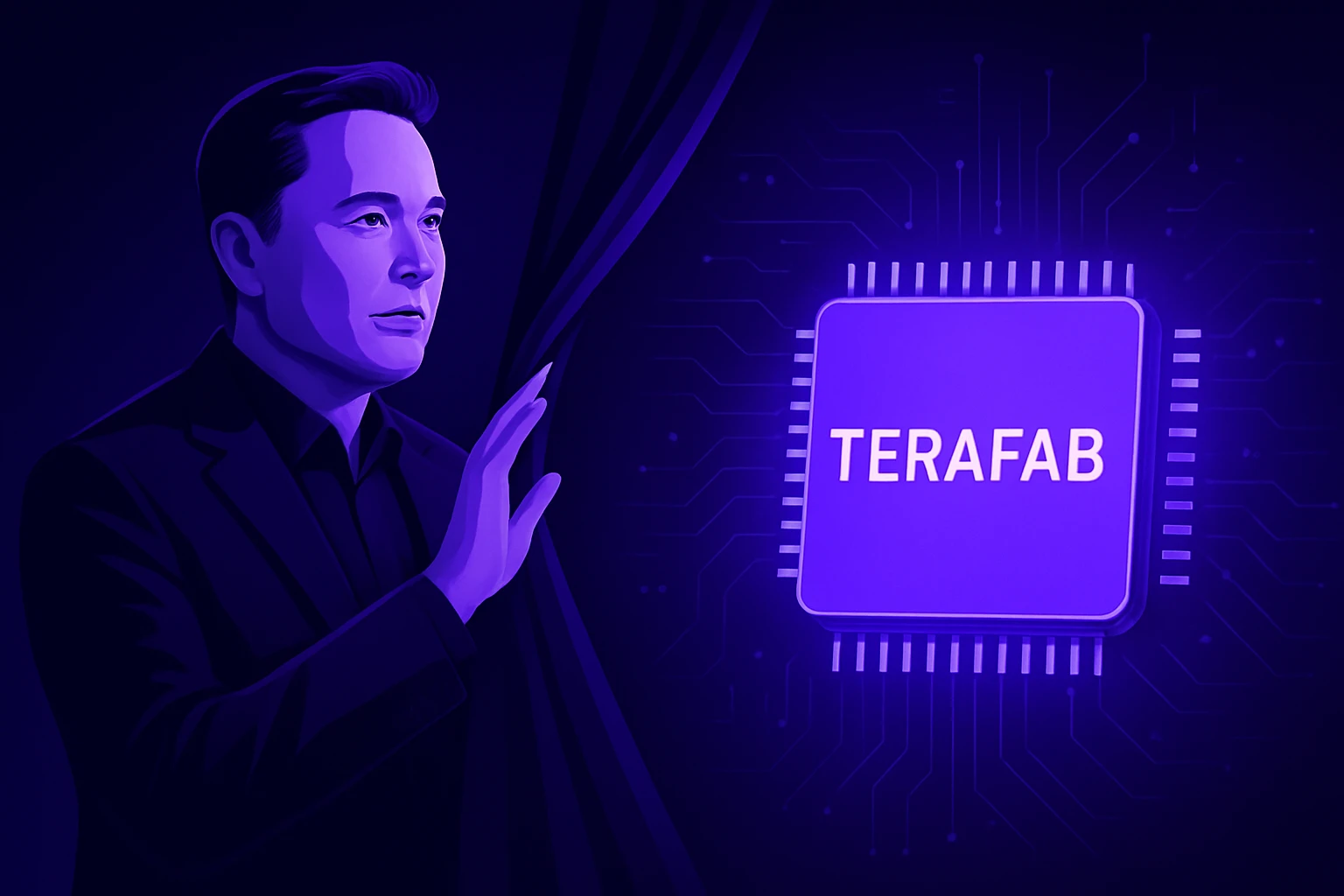
Elon Musk’s newly unveiled TeraFab is being framed as one of the most ambitious AI infrastructure plans announced in 2026. Reported by outlets including Tom’s Hardware and Axios on March 22 and 23, the project is described as a $20 billion effort to build chips, memory, and advanced packaging under one roof, with the stated goal of enabling 1 terawatt of annual AI compute output. That scale immediately sets TeraFab apart from conventional semiconductor announcements and positions it as a broader industrial strategy rather than a simple factory expansion.
The timing matters. As of March 25, 2026, TeraFab is a very recent development, and its unveiling arrives amid intensifying concern over AI infrastructure bottlenecks. The current debate is no longer only about which company has the best model, but about who can secure enough chips, packaging capacity, electrical power, and deployment architecture to sustain the next generation of AI systems. In that sense, Musk unveils TeraFab not just as a manufacturing project, but as a proposal to reshape the economics and geography of compute itself.
A record chip-building plan with terawatt ambition
Axios characterized TeraFab as a “record chip-building plan,” and that description captures why the announcement has drawn so much attention. Musk’s line target is 1 trillion watts, or 1 terawatt, of annual AI compute capacity. Even in an industry accustomed to giant numbers, terawatt-scale rhetoric is extraordinary, because it shifts discussion from clusters and datacenters to something closer to planetary infrastructure.
Recent reports indicate that Musk presented TeraFab as a vertically integrated operation. Rather than focusing only on wafer production, the project is said to combine chip fabrication, memory production, and processor packaging in a single coordinated system. That matters because advanced AI hardware is constrained not only by chip design, but also by memory bandwidth, supply chain coordination, and increasingly scarce packaging technologies.
The $20 billion figure attached to the project is also notable. Semiconductor fabs are already among the most capital-intensive industrial assets in the world, and TeraFab appears to go beyond the standard fab concept by combining multiple stages of production into one platform. If executed at anything close to the announced scale, it would represent a major attempt to control more of the AI hardware stack internally rather than relying on fragmented external suppliers.
Why Musk is tying compute to space
One of the most striking aspects of the TeraFab presentation is that it was not limited to terrestrial manufacturing. Tom’s Hardware reported that Musk projected roughly 100 to 200 gigawatts per year of chip output on Earth, with the remainder of the path toward 1 terawatt linked to space-based AI compute deployed on solar-powered satellites. In other words, the factory concept is being paired with an orbital deployment model from the start.
This is consistent with Musk’s broader strategic thesis that the lowest-cost way to generate AI compute may soon be in space. TechRadar highlighted that claim while also noting how speculative it sounds today. The logic, at least in theory, is that solar-powered satellites could access abundant energy without many of the land, grid, and cooling constraints that limit terrestrial datacenter expansion.
The orbital angle is not being presented as pure fantasy detached from existing regulatory steps. According to Tom’s Hardware, Musk linked the plan to solar-powered satellites that SpaceX has already discussed with the FCC. That means TeraFab is being pitched less as a standalone semiconductor plant and more as part of a wider system that includes manufacturing, launch capability, and off-Earth compute deployment.
From Memphis to terawatt-scale infrastructure
TeraFab did not emerge in a vacuum. Earlier in 2026, Tom’s Hardware reported that Musk said xAI would expand its Memphis training footprint toward 2 gigawatts with a third building. That was already an aggressive signal about the scale of infrastructure Musk wanted to assemble for AI training, and it fit with his stated desire to have “more AI compute than everyone else.”
Against that backdrop, TeraFab looks like the next escalation. If one compares the reported 1 terawatt annual ambition with the roughly 2 gigawatt Memphis target, the result is an arithmetic ratio of about 500 to 1. That does not mean the two systems are directly equivalent, but it does illustrate how much larger the TeraFab vision is in power-equivalent terms than even a massive training campus.
This comparison helps explain why the unveiling feels different from a standard datacenter announcement. The Memphis expansion was about building more AI capacity within a known model of terrestrial infrastructure. TeraFab, by contrast, suggests that Musk now sees the AI race as one that will be won by those who can industrialize compute production itself at unprecedented scale.
Vertical integration as the real strategic play
The most important feature of TeraFab may be vertical integration. Reports say the project aims to produce chips, memory, and advanced packaging under one roof. In the current AI hardware market, that is a powerful proposition because bottlenecks often emerge in the handoffs between specialized suppliers. A company may secure chip designs but still be constrained by high-bandwidth memory availability or by advanced packaging capacity.
By presenting TeraFab as an integrated manufacturing complex, Musk is effectively reframing AI competition as a full-stack industrial contest. The relevant assets are no longer only models, data, and software talent. They also include semiconductor process capacity, packaging know-how, power access, launch systems, and physical deployment channels. That is a much broader battlefield than the one many investors and observers focused on only a year or two ago.
This is also why recent coverage has connected the concept to Musk’s wider corporate ecosystem, especially SpaceX, Tesla, and xAI. While the exact corporate structure remains unclear in mainstream reporting, the logic of the plan points toward cross-company coordination. SpaceX brings launch capability, xAI provides demand for training compute, and Tesla offers manufacturing and energy-system experience. TeraFab makes the most sense when viewed as an ecosystem play rather than an isolated fab project.
The energy constraint behind the announcement
There is a deeper reason why TeraFab emphasizes power as much as chips. AI infrastructure is increasingly constrained by electricity supply, grid access, and cooling, not just semiconductor availability. A recent Telegraph report cited the International Energy Agency’s estimate that global datacenters consumed roughly 415 terawatt-hours of electricity in 2024, around 1.5% of global demand, with usage potentially more than doubling by 2030 as AI adoption expands.
That backdrop makes Musk’s emphasis on generation and deployment architecture easier to understand. If power becomes the dominant bottleneck, then simply buying more processors is not enough. The companies that win may be those that can pair compute with scalable energy systems, whether that means massive terrestrial campuses, co-located generation, or eventually solar-powered orbital platforms.
Seen this way, TeraFab is part semiconductor story and part energy story. The promise of 1 terawatt of annual AI compute is not just about manufacturing throughput. It is also about finding places and systems where that compute can be powered economically. That helps explain why the unveiling blended chip production with satellites, launch imagery, and long-range infrastructure concepts.
Vision, spectacle, and skepticism
Musk reportedly framed the future enabled by TeraFab in terms of “amazing abundance,” a phrase highlighted by Axios. That language fits his long-standing tendency to present industrial projects as stepping stones toward civilizational transformation. In this case, the abundance story rests on the idea that enough compute, energy, and automation could radically lower the cost of intelligence and unlock new capabilities across the economy.
The presentation also leaned into visual spectacle. Axios, citing Bloomberg’s description, reported that Musk showed an animation of how SpaceX could potentially launch satellites from the surface of the moon. That imagery underlined how the unveiling blended near-term manufacturing goals with far-future off-Earth infrastructure ideas. For supporters, this expands the ambition of the project. For critics, it risks blurring the line between executable plan and aspirational theater.
That skepticism is already visible in media coverage. While Axios and Tom’s Hardware treated TeraFab as a significant new industrial ambition, TechRadar argued that Musk’s suggestion that space-based AI compute could become the cheapest option within a few years sounds closer to science fiction than practical strategy. The tension between audacity and feasibility is likely to define the next phase of the conversation around TeraFab.
Why TeraFab matters for the AI race
The most significant implication of TeraFab is that it reframes the AI race. For much of the last few years, public attention has centered on model launches, chatbot features, and benchmark performance. TeraFab shifts focus toward a harder question: who will own the industrial base required to train and deploy advanced AI at scale? That includes fabrication, memory, packaging, electricity, cooling, launch systems, and distribution architecture.
If Musk’s plan gains traction, competitors may be pushed to think beyond datacenter leasing and GPU procurement. They may need deeper control over semiconductor supply chains, more direct involvement in energy infrastructure, and closer integration between hardware manufacturing and AI platform strategy. In that sense, TeraFab could influence the industry even if its most ambitious orbital components take far longer to materialize than Musk suggests.
It also arrives at a moment when infrastructure narratives are becoming central to AI leadership. The companies that dominate the next era may not simply be the ones with the best algorithms, but the ones capable of mobilizing capital, construction, energy, and manufacturing faster than everyone else. Musk unveils TeraFab as a bet that industrial capacity, not just software ingenuity, will determine who leads the future of AI.
Whether TeraFab ultimately becomes a transformative manufacturing platform or remains a provocative vision, its unveiling has already changed the tone of the AI infrastructure debate. A $20 billion project targeting 1 terawatt of annual compute output is large enough to force investors, policymakers, and rivals to reassess what “scale” now means in the age of AI. Even the terrestrial portion alone, at an indicated 100 to 200 gigawatts per year, would represent a huge undertaking by current standards.
For now, the project sits at the intersection of bold engineering ambition and substantial execution risk. Yet that combination is precisely why TeraFab is commanding attention. It is not merely a story about another chip facility. It is a story about an attempt to control the full stack of AI production, from silicon and packaging to power generation, satellite deployment, and perhaps eventually compute in orbit.