


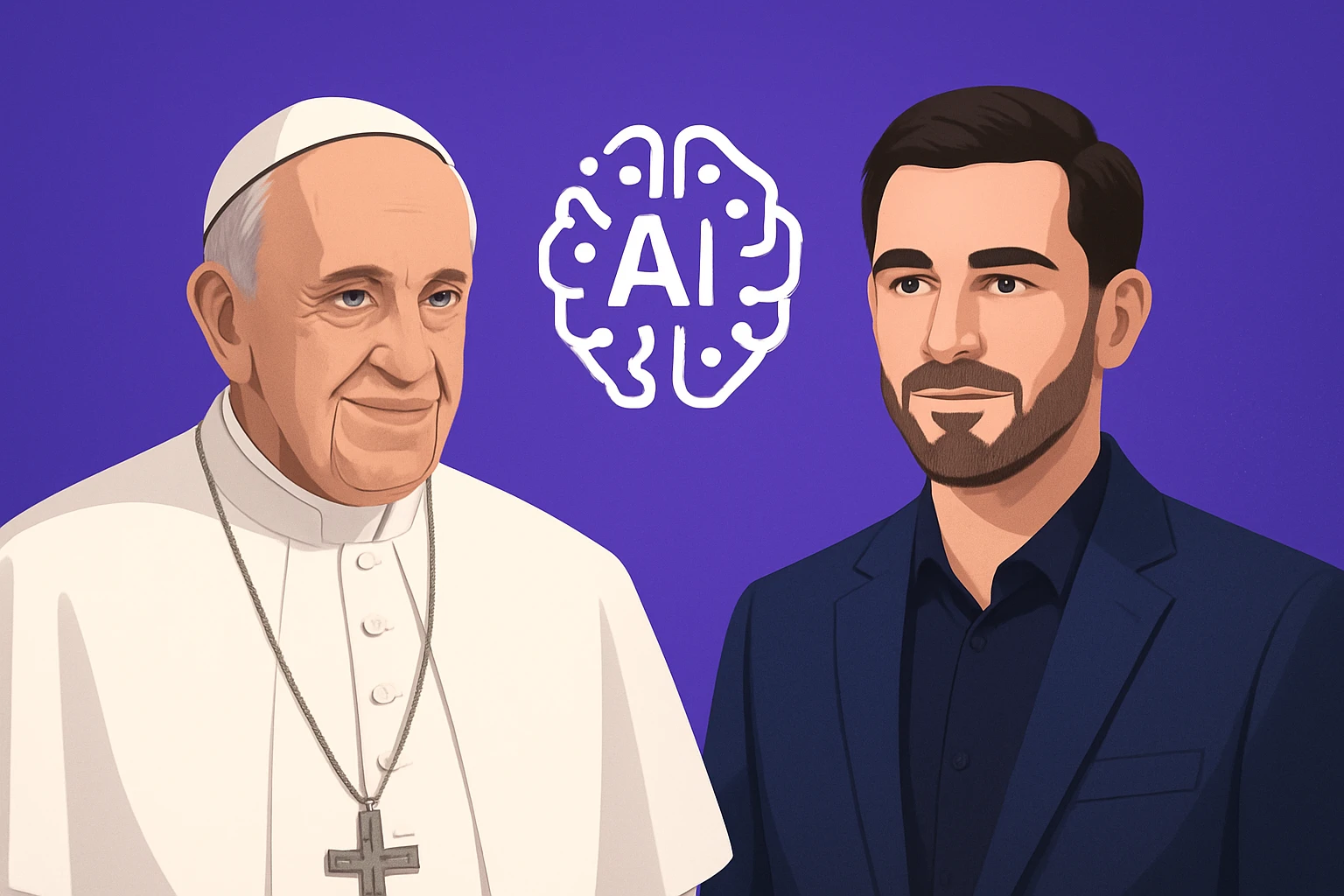
The Vatican is preparing a closely watched moment at the intersection of faith, ethics, and technology. On May 25, 2026, Pope Leo XIV is set to present his first encyclical on artificial intelligence, a document titled Magnifica Humanitas. According to the Holy See Press Office, the text is focused on “Safeguarding the Human Person in the time of Artificial Intelligence,” signaling that the Church wants the AI debate to be framed not only around innovation, but around the meaning and protection of human dignity.
The launch has attracted unusual global attention because it will not be a routine Vatican book release. The presentation is scheduled in the Synod Hall, with the pope present, and the speaker list includes Christopher Olah, the co-founder of Anthropic and a leading figure in AI interpretability research. That combination of papal authority, theological reflection, and direct participation from a prominent AI executive makes this one of the most striking public encounters yet between the Catholic Church and the AI industry.
A landmark Vatican event on May 25
The Vatican’s public calendar confirms that the presentation and promulgation of Magnifica Humanitas will take place on May 25, 2026, in the Synod Hall. As of May 22, the event is only three days away, adding to the sense of anticipation around what could become one of the defining moral statements on AI from any global institution this year.
The Holy See has also made clear that Pope Leo XIV will be present at the event. The program includes remarks from senior Vatican officials and academics, followed by an “intervention and blessing” from the pope himself. Reuters-linked reporting and other outlets have noted how unusual this is, since popes do not often publicly present their own encyclicals in such a visible launch setting.
That unusual format matters because it elevates the significance of the document before a word of it has even been publicly discussed in full. By placing the pope at the center of the launch, the Vatican is signaling that AI is not a niche policy concern, but a major pastoral, social, and civilizational issue that deserves the highest level of attention from the Church.
Why this encyclical matters
An encyclical is one of the most authoritative forms of papal teaching, and the fact that Pope Leo XIV has chosen AI as the subject of his first such document is itself significant. It suggests that artificial intelligence is no longer seen simply as a technical field or a business trend, but as a force with consequences for labor, social life, moral responsibility, and the understanding of the human person.
The Vatican’s own wording points to the core theme: “Safeguarding the Human Person in the time of Artificial Intelligence.” Other reports, including from the Associated Press, say the document addresses the care of human dignity in the era of AI. Taken together, those descriptions show remarkable consistency in the Vatican’s message. The central question is not whether AI can become more powerful, but whether societies can ensure that technological development remains aligned with human worth.
This framing sets the Church apart from many public discussions about AI, which often focus on productivity, market competition, or geopolitical leadership. The Vatican is instead placing anthropology and ethics first. In practical terms, that means asking how AI affects workers, families, vulnerable communities, truth, decision-making, and the moral habits of societies that increasingly rely on machine-generated outputs.
The meaning of Magnifica Humanitas
The title Magnifica Humanitas points directly to a positive but demanding vision of humanity. Rather than treating the human person as an obstacle to efficiency, the title suggests that human dignity, creativity, and moral agency must remain central in any technological age. Even before publication, the title indicates that the pope’s concern is not merely to warn about AI, but to articulate a richer account of what human life should be protected for.
The encyclical bears the signature date of May 15, 2026, a detail the Vatican itself has highlighted. That date marks the 135th anniversary of Rerum Novarum, Pope Leo XIII’s landmark encyclical on labor, social justice, and the dignity of workers. By choosing that anniversary, Pope Leo XIV appears to be placing AI within the long arc of Catholic social teaching, especially where economic change and human dignity intersect.
The symbolic connection is important. Rerum Novarum addressed the upheavals of industrial capitalism and argued that labor could not be reduced to a commodity. In a similar way, Magnifica Humanitas may be read as the Church’s attempt to respond to a new technological revolution, one in which data, automation, and algorithmic systems risk reducing persons to inputs, profiles, or disposable functions.
Christopher Olah and the Anthropic connection
One of the most discussed elements of the launch is the presence of Christopher Olah, officially listed by the Vatican as a co-founder of Anthropic and of research on the interpretability of artificial intelligence. His participation is notable not only because he comes from a major AI company, but because his work centers on interpretability, a field concerned with making AI systems more understandable to humans.
Anthropic has become one of the most visible firms in AI safety and policy debates, so the Vatican’s decision to include one of its co-founders as a speaker sends a clear signal. It suggests the Church does not want this encyclical to remain inside theological or ecclesial circles. Instead, it appears to be inviting direct engagement with the people building and studying advanced AI systems.
That does not mean the Vatican is endorsing any one company or platform. Rather, the choice of speaker implies that technical insight and moral reflection need to meet in public, especially when societies are grappling with opaque systems that may influence education, work, media, health care, and governance. The emphasis on interpretability is especially fitting for a Church that has repeatedly insisted on human responsibility, moral clarity, and accountability.
The Vatican’s broader AI strategy
The encyclical is not emerging in isolation. On May 16, 2026, the Holy See approved a new inter-dicasterial AI commission designed to coordinate information and policy on artificial intelligence across Vatican offices. The decree cited the rapid spread of AI and its effects on humanity and human dignity, making clear that the Vatican now sees AI as a matter requiring institutional coordination, not occasional commentary.
This new commission shows that the Church is moving from general ethical concern toward a more structured response. Inter-dicasterial coordination means multiple parts of the Vatican are being asked to work together on a common challenge. That is significant because AI touches nearly every major area of Church interest: education, social teaching, communication, diplomacy, labor, development, and moral theology.
The commission decree also reinforces the Vatican’s preferred framework. AI is treated as a human-dignity issue tied to integral development, a phrase with deep roots in Catholic social thought. In other words, the Vatican is not asking only whether AI is efficient or useful. It is asking whether it contributes to the full flourishing of persons and communities, especially those most at risk of exclusion or exploitation.
Human dignity as the central lens
Pope Leo XIV has repeatedly tied AI to human dignity in Vatican messaging, and the coming encyclical appears to crystallize that approach. In recent Vatican documents and speeches, ethical governance, dignity, and human development have been presented as the core standards for evaluating AI. That language suggests the Church wants a normative framework that can guide lawmakers, developers, institutions, and ordinary users alike.
This emphasis also aligns with the January 28, 2025 doctrinal note Antiqua et nova, which presented the Church’s reflection on AI in explicitly ethical and anthropological terms. That text cited Pope Francis on the “intrinsic dignity” of every person as a key criterion for evaluating emerging technologies. The continuity is striking: from Francis to Leo XIV, the Vatican has been building a coherent argument that AI must be judged by what it does to persons, not merely by what it can do technically.
In practical terms, a dignity-based lens could influence debates about surveillance, automated decision-making, job displacement, deepfakes, bias, intellectual dependency, and even the spiritual effects of delegating judgment to machines. The Vatican’s likely contribution is to insist that these are not just engineering problems or regulatory details. They are questions about the kind of society people are becoming under the pressure of increasingly capable systems.
Why the launch is drawing attention beyond Catholic circles
The upcoming presentation stands out because it combines several elements rarely seen together: a papal encyclical, a live Vatican launch with the pope present, and participation by a co-founder of a major AI company. That is why reporting from Reuters-linked outlets and others has stressed the unusual character of the event. It is not simply a Church publication; it is also a public intervention in one of the biggest global debates of the decade.
The timing adds to the importance. AI policy conversations are intensifying around the world, and many governments, companies, and civil society groups are still struggling to define workable principles for governance. By releasing Magnifica Humanitas now, the Vatican is trying to enter that debate with a moral vocabulary shaped by centuries of reflection on personhood, justice, labor, and the common good.
There is also a broader symbolic dimension. The Catholic Church is one of the world’s oldest global institutions, while frontier AI companies represent one of the newest and fastest-moving concentrations of power. Bringing those worlds together on the same platform creates a moment that invites reflection far beyond religious audiences. It suggests that questions about AI are now so profound that they demand conversation across traditions, disciplines, and centers of authority.
Whether Magnifica Humanitas becomes a lasting reference point will depend on the substance of its arguments, but the context of its release already tells an important story. The Vatican is positioning AI as a defining moral issue of the present age, and Pope Leo XIV appears determined to address it at the highest level of Church teaching. The choice to link the text to Rerum Novarum and to launch it alongside voices from the technical AI world gives the event both historical depth and contemporary urgency.
For readers, policymakers, and technology leaders, the significance of this moment lies in its core claim: artificial intelligence must be evaluated according to what it means for the human person. With Pope Leo XIV set to present his AI encyclical alongside Anthropic co-founder Christopher Olah on May 25, 2026, the Vatican is making a public case that the future of AI cannot be decided by capability alone. It must also be judged by dignity, responsibility, and the kind of humanity societies choose to defend.