

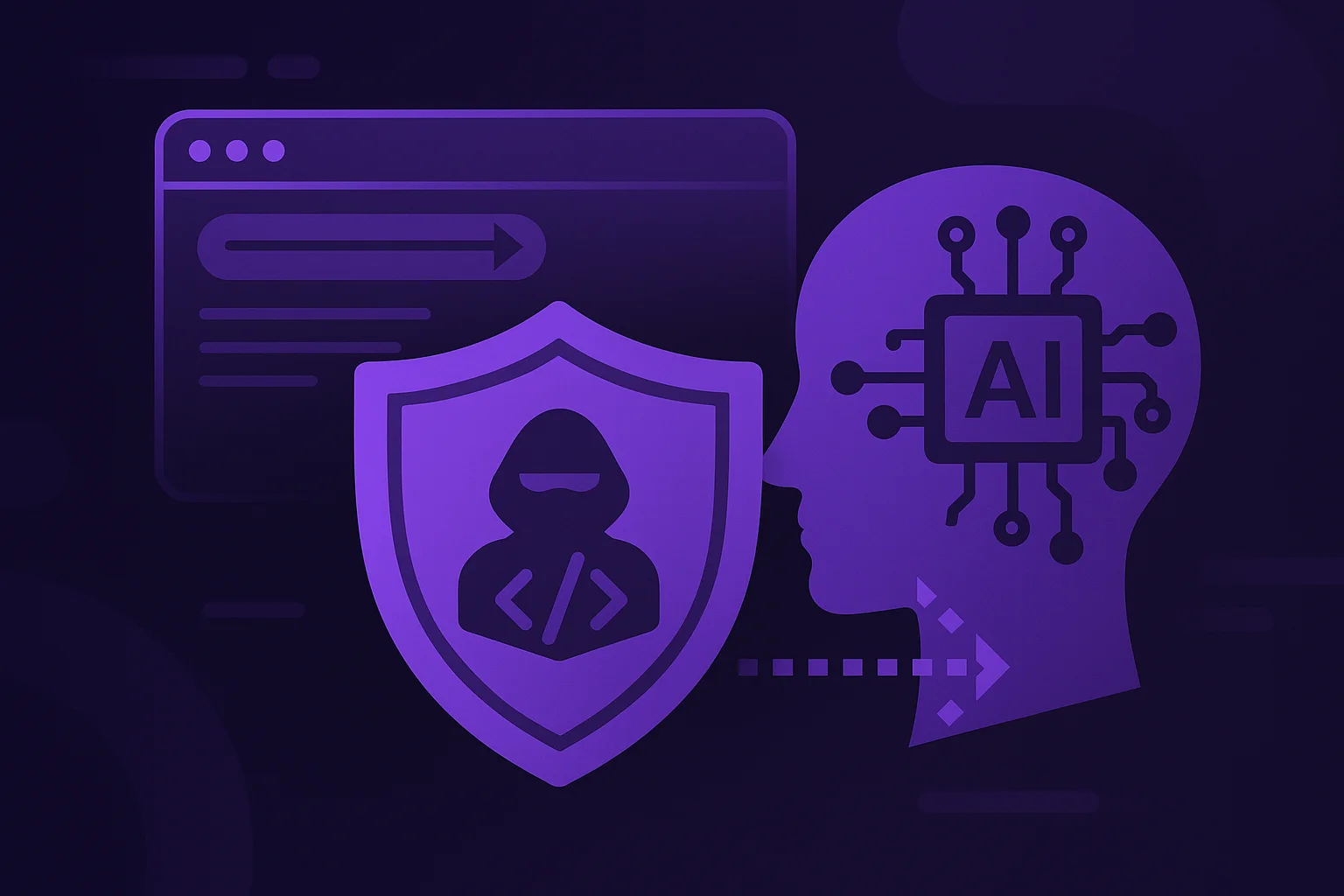
The emergence of browser AI agents has created new conveniences and new attack surfaces. These agents combine web browsing, search, and large language model reasoning into autonomous flows that can answer questions, execute tasks, and interact with web pages on a user's behalf. That capability is powerful, but it also opens a vector where webpage content itself can become an instruction channel, producing prompt injection risks that target browser AI agents.
Researchers, vendors, and incident responders have documented multiple proof of concepts and real incidents where hidden or crafted web content tricked agents into executing sensitive actions. From audits of Perplexity's Comet to academic benchmarks like WASP and automated red teams like AgentXploit, the evidence shows a persistent arms race: attackers find novel injection techniques while researchers and vendors iterate mitigations. The stakes include data exfiltration, unauthorized purchases, and leaking credentials or tokens.
How browser AI agents expand the web attack surface
Browser AI agents act as decision-making intermediaries between users and the web. Instead of simply rendering a page, an agent ingests text, extracts intent, and issues follow-up actions such as filling forms, clicking links, or using connected services. That decision loop turns arbitrary page content into input that can change system behavior.
That model breaks many assumptions of classic web security. Mechanisms like same-origin policy and CORS are about preventing cross-origin code execution, but they do not stop an agent from reading or following instructions embedded in page text, comments, or URL parameters. As Brave researchers put it, these attacks present significant challenges to existing web security mechanisms.
Because agents often glue together multiple capabilities and connectors, a single injected instruction can cascade: a crafted page can prompt retrieval of email or calendar data, instruct the agent to copy encoded content into a connected service, or initiate purchases using stored payment methods. The combination of readability plus tooling access is what makes prompt injection risks so consequential for browser AI agents.
Real-world incidents and disclosure timelines
Several high-profile audits and disclosures illustrate how prompt injection risks have moved from theory to practice. Brave's audit of Perplexity's Comet found that Comet would pass raw page content to its LLM, allowing hidden instructions to be executed. Brave discovered the vulnerability on 25 July 2025, exchanged reports and fixes in late July, and published a public disclosure on 20 August 2025 while continuing retests as vendors iterated mitigations.
Further research escalated the concern. Guardio and independent auditors showed Comet could be tricked into autofilling payment details or making purchases on fraudulent shops. Later in 2025 a LayerX proof of concept called CometJacking embedded malicious instructions in a URL parameter to retrieve and exfiltrate connected Gmail and Calendar data encoded to evade filters, demonstrating one-click data theft without credential theft. The CometJacking reports were disclosed to Perplexity in late August and made public in October 2025.
These incidents fit into a broader timeline that includes earlier findings. The Guardian noted in December 2024 that hidden or obfuscated text could manipulate search and summarization LLMs, and academic work throughout 2025 (WASP, AgentXploit) documented systematic vulnerability to both manual and automated prompt injections. The pattern is clear: research labs and vendors are discovering practical techniques as attackers and red teams scale testing tools.
Common attack techniques and automated tooling
Attackers use a spectrum of techniques to inject instructions into agent workflows. Simple methods include hidden text, HTML comments, zero‑width characters, or anomalous typographic patterns that are readable by an LLM but invisible to users. URL-based injections encode directives in query parameters, for example embedding base64 payloads in a collection parameter that the agent later decodes and executes.
Automated tools and benchmarks have amplified discovery and exploitation. WASP showed agents begin following adversarial instructions between 16% and 86% of the time in tested scenarios, while AgentXploit reported success rates near 70% against some agent benchmarks. Those frameworks can fuzz pages, craft payloads, and find indirect injection paths at scale, proving that low-effort human attacks are not the only concern.
Attackers also combine injection techniques with social engineering. Guardio demonstrated practical scams against AI browsers, including fake e-commerce flows where agents completed purchases and autofilled saved cards, and phishing sequences where agents visited malicious login pages and assisted credential harvesting. These flows highlight that technical injection is often paired with UX manipulations to yield real-world harm.
Measured impacts: rates, partial control, and end-to-end outcomes
Empirical studies reveal an important nuance: attackers often get agents to start following injected instructions more frequently than they achieve complete end goals. WASP reported high rates of partial instruction execution but much lower end‑to‑end success in finishing an attacker goal. Researchers call this phenomenon security by incompetence, where partial control is common but full exploitation requires more conditions.
Other measurements are starker. Anthropic's internal pilot of Claude-for-Chrome found prompt-injection attacks succeeded 23.6% of the time without mitigations and 11.2% in an autonomous mode after safety measures were applied. The residual 11.2% prompted public alarm; commentators like Simon Willison described such a rate as catastrophic in the absence of 100% reliable protection.
Automated red teams tell a mixed story as well. AgentXploit and similar frameworks show high discovery and attackability in lab settings, while defense papers show some mitigations can reduce attack success to near zero in controlled evaluations. In practice, the outcome varies with agent tooling, connectors enabled, and deployed defenses, which is why the community treats the issue as an active arms race rather than a solved vulnerability.
Defenses: research advances and product mitigations
Defensive research is rapidly evolving. AgentArmor treats agent runtime traces as structured programs and applies program analysis and type-system checks to detect prompt-injection behaviors, reporting high true positive rates with low false positives in experiments. Multi-agent defense pipelines use defender agents to cross-check actions and in one paper reduced attack success from baseline levels to zero across a large evaluation of attacks.
Product vendors are also deploying practical mitigations. 1Password introduced Secure Agentic Autofill, which prevents agents from directly seeing stored credentials by requiring a human confirmation and injecting secrets via an encrypted channel so the LLM never sees them. Brave recommends treating page content as untrusted, separating user instructions from webpage content, asking for explicit human confirmation for sensitive actions, and isolating agentic browsing from normal browsing.
Other pragmatic defenses include site-level permissions and blocklists for high-risk connectors, instrumenting agent outputs with independent classifiers and program-analysis checks, logging and auditing agent actions, and requiring human-in-the-loop approval for purchases, logins, and data exports. These practices mirror the layered defenses researchers recommend and provide immediate risk reduction while more robust methods are developed.
Practical guidance for defenders and policy implications
For organizations and defenders the immediate playbook is straightforward. Disable or restrict agentic features on high-risk endpoints, require explicit human confirmation for any security-sensitive action, and limit connectors such as mail, calendar, and payment access. Log and audit agent activity and prioritize suppliers who publish red-team results and fixed timelines.
Deploy multi-layer detection that combines behavioral anomaly detection, alignment classifiers, and program-analysis techniques. Use blocklists for known malicious sites and instrument agents so they separate trusted user intent from untrusted context before sending text to an LLM. These steps are recommended across academic and vendor guidance and have been shown to reduce attack surface in controlled tests.
Policy makers and platform owners must also weigh broader implications. Experts urge caution before wide releases of autonomous browsing features, arguing that classic web security boundaries are eroded when agents freely read page content. Until provable mitigations become standard, many researchers recommend delaying feature rollouts and demanding robust, reproducible red-team testing and public disclosures of mitigations.
Prompt injection risks targeting browser AI agents are real and evolving. The combination of research benchmarks, audits, and practical PoCs shows attackers can find both simple and sophisticated paths to influence agent behavior, while defenses are improving but not universally deployed.
The path forward requires layered technical defenses, product design choices that prioritize human confirmation and zero-exposure of secrets, transparent red-teaming by vendors, and sensible rollout policies. Treat page content as untrusted, separate intent from context, and instrument agents with independent checks, doing so will reduce risk while the research community advances more formal, provable protections.