

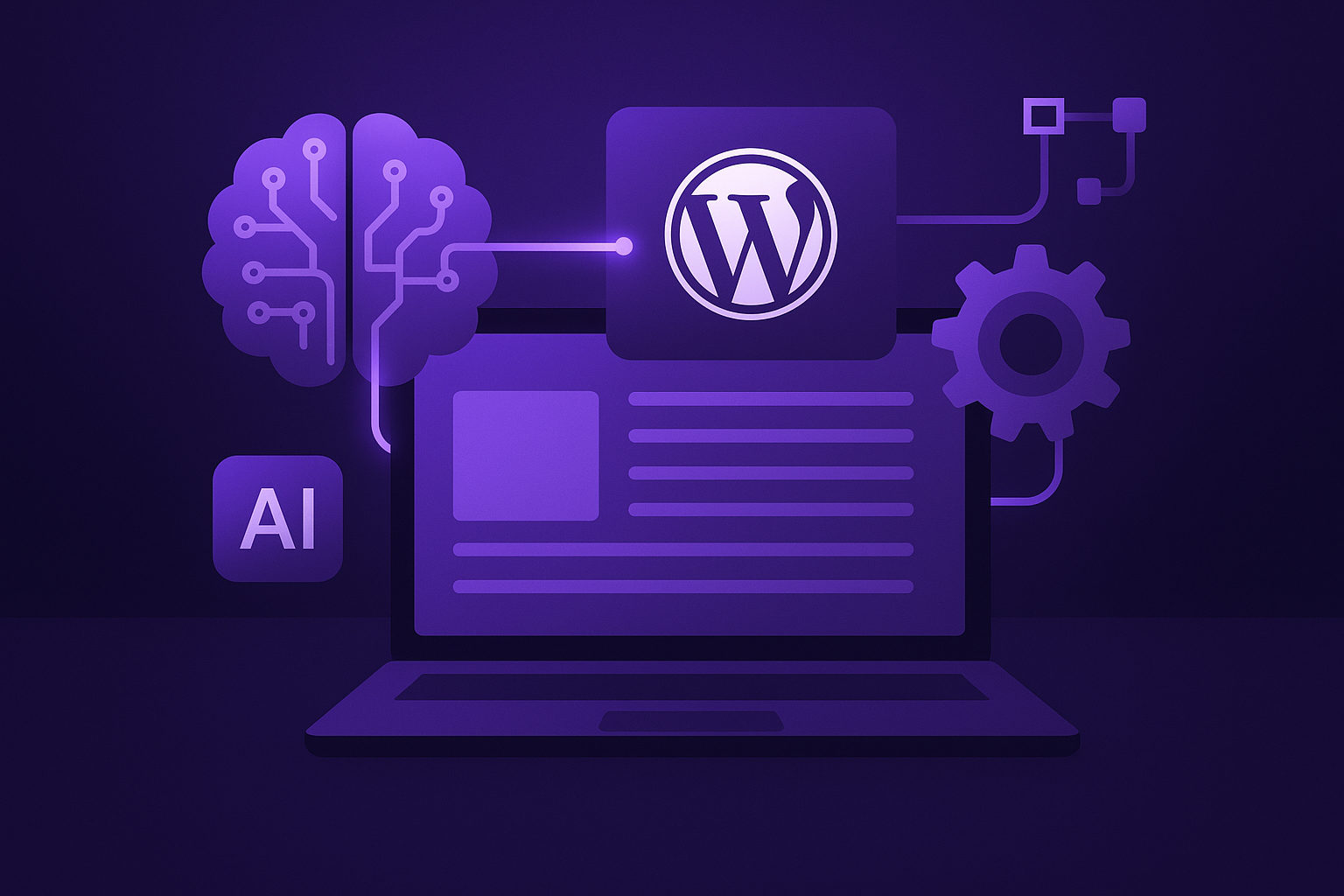
AI blog automation is moving from brittle, one-off integrations toward standardized interfaces that let tools understand what a WordPress site can safely do. With WordPress 6.9+, the new WordPress Abilities API introduces a central registry for “capability discovery” that is both machine-readable and human-friendly, exactly the kind of foundation automation systems (including AI agents) have been missing.
Instead of hard-coding assumptions about roles, endpoints, or plugin-specific actions, an AI workflow can discover registered “abilities,” validate inputs against schemas, and run tasks through a permission-checked execution pipeline. That shift matters for anything from drafting posts to updating metadata at scale, because it makes automation safer, more interoperable, and easier to audit.
1) From ad-hoc automation to capability discovery in WordPress
Traditional AI blog automation often relies on custom REST endpoints, direct database writes, or plugin-specific APIs that change over time. Even when it works, the automation usually “guesses” what a site supports, which can lead to failed runs, unexpected side effects, or security gaps.
The WordPress Abilities API (shipping first implementations in WordPress 6.9) addresses this by providing a central registry where capabilities (called “abilities”) are registered in a standardized way. The API is explicitly designed so automation tools across platforms, including AI agents, can read what’s available and how to use it.
The Abilities API Handbook positions Abilities as a standardized interface for external systems (like AI agents) to understand and interact with site capabilities. In practice, that means an AI automation tool can stop scraping documentation or reverse-engineering endpoints and instead ask WordPress directly: “What can I do here, and what inputs do you require?”
2) Abilities as composable, automation-friendly units of functionality
An “ability” is designed to be a small, composable unit of functionality rather than a vague, human-only concept like “manage options.” Each ability uses a unique identifier following the namespace/ability-name pattern, which makes it easier to group and combine actions across plugins and sites.
For AI blog automation, this naming convention helps create predictable toolchains. A plugin could expose my-editorial/create-draft, my-editorial/update-seo-meta, and my-editorial/schedule-post as separate abilities, allowing an agent to plan multi-step workflows without requiring a single monolithic endpoint.
Because abilities live in a central registry that is both machine-readable and human-friendly, teams can document these actions once and reuse them across editorial UIs, CI pipelines, and external AI services. This also supports better governance: the site can enumerate what’s exposed and what is not.
3) Registration details that matter for plugin-driven automation
On the implementation side, the API makes registration deterministic. Ability registration in PHP uses wp_register_ability, and it must be called inside a callback hooked into the wp_abilities_api_init action. That hook requirement is important for plugin authors who want their automation hooks to be reliably available when the registry is built.
This “register at init” approach reduces race conditions where an automation system queries for abilities before a plugin has registered them. For AI blog automation tools that run on schedules or event triggers, consistent discovery is a major operational advantage.
It also supports a migration path from plugin/Composer experimentation into WordPress Core. Core status notes indicate the first implementations are approved for WordPress 6.9 and are designed to migrate from plugin-based development into Core over time, suggesting the interface is intended to be stable enough for ecosystem-wide adoption.
4) Schema-first automation: predictable inputs and outputs for AI
A frequent failure mode in AI automations is malformed input: wrong types, missing required fields, or unexpected structures. The Abilities API is schema-first: abilities can define input_schema and output_schema, and WordPress can automatically validate them.
This matters when an AI agent is generating parameters dynamically. If an ability expects an integer and the agent provides a string, the API can raise a validation error and stop execution, preventing partial updates or confusing side effects. That’s a strong fit for editorial operations where correctness matters as much as speed.
Just as importantly, output validation helps keep downstream automation stable. If the execution returns data that doesn’t match the declared output schema, the pipeline can catch it early. For AI blog automation, this turns “best effort” integrations into contract-driven integrations that are easier to test and monitor.
5) Security-first execution: permissions enforced in PHP and REST
AI automation is only as safe as its permission model. Each ability can require a permission_callback, and the API enforces permissions consistently, both when executing abilities in PHP and when executing them via REST.
WordPress Core’s REST execution pipeline for abilities is designed to be defensive by default: it validates the input, checks permissions, executes the ability, validates the output, and returns the result as JSON. For AI blog automation, that sequence is crucial because it reduces the risk of silent failures or unauthorized actions.
In practical terms, a site can expose “draft creation” to editors but restrict “publish” or “update site settings” to administrators, even if the same AI tool is used. Abilities encourage designing automation tasks with least-privilege in mind, rather than granting broad access to a generic endpoint.
6) REST exposure, discovery endpoints, and authenticated automation
Remote AI blog automation usually requires hitting WordPress over HTTP. The Abilities API supports this via opt-in REST exposure per ability through meta.show_in_rest. If enabled, the ability becomes available via the Abilities REST API endpoints by default.
The REST namespace is wp-json/wp-abilities/v1, and key endpoints include discovery and execution: GET /wp-json/wp-abilities/v1/abilities to list abilities, GET /wp-json/wp-abilities/v1/{namespace/ability} to fetch one, and GET|POST /wp-json/wp-abilities/v1/{namespace/ability}/run to execute. This makes “capability discovery” a first-class part of automation, not an afterthought.
Authentication is required for all Abilities REST API endpoints, and application passwords are recommended for external access. That combination, authenticated requests plus ability-level permission callbacks, lets an external agent draft, update, or schedule posts safely, assuming the relevant actions are registered as abilities by core or plugins.
7) Editor-side automation with the JavaScript client
Not all AI blog automation runs outside WordPress; some of the most useful workflows live in the editorial experience. The Abilities API includes a JavaScript client that provides built-in support for fetching and executing abilities without hand-rolling REST calls.
That makes it easier to build AI-assisted features in Gutenberg or custom admin screens. For example, an editorial UI could let a user select an ability and run it with structured inputs, while WordPress handles schema validation and permission checks behind the scenes.
The execution pattern is straightforward: import executeAbility from @wordpress/abilities and call executeAbility( 'namespace/ability', input ). This design encourages consistent tooling, so the same abilities can be invoked from the editor, from a CI job, or from a remote AI service.
8) Agent ecosystems and MCP: turning abilities into AI “tools”
The Abilities API is framed as part of “AI Building Blocks for WordPress,” with goals that include discoverability, interoperability, and a security-first approach. That positioning is important: it signals that abilities are meant to be shared, discovered, and orchestrated by automation systems, not just used internally by one plugin.
One concrete path to agent-based automation is through protocol adapters. Make WordPress AI highlights that assistants can discover WordPress capabilities through adapters like an MCP (Model Context Protocol) Adapter, enabling AI systems to treat abilities as invokable tools.
The WordPress MCP Adapter bridges the Abilities API to MCP so MCP clients can discover and invoke abilities programmatically. Abilities registered via wp_register_ability are automatically exposed through a default MCP server, supporting HTTP and STDIO, with an HTTP entry point at /wp-json/mcp/mcp-adapter-default-server. Recent MCP Adapter v0.3.0 notes emphasize transport, observability, error-handling improvements, and alignment with Abilities API versions, features that matter when you’re operating AI blog automation in production.
AI blog automation taps the WordPress Abilities API most effectively when abilities are treated as contracts: clearly named, schema-validated, and permission-checked units that can be discovered and executed reliably. WordPress 6.9’s first implementations, combined with opt-in REST exposure and authenticated access (often via application passwords), provide a practical route to safe remote automation.
As more plugins register editorial and publishing actions as abilities, and as adapters like MCP make those abilities visible to agent frameworks, the ecosystem can shift from fragile integrations to standardized automation. The result is an AI-friendly WordPress that can scale content operations without sacrificing security, predictability, or maintainability.