

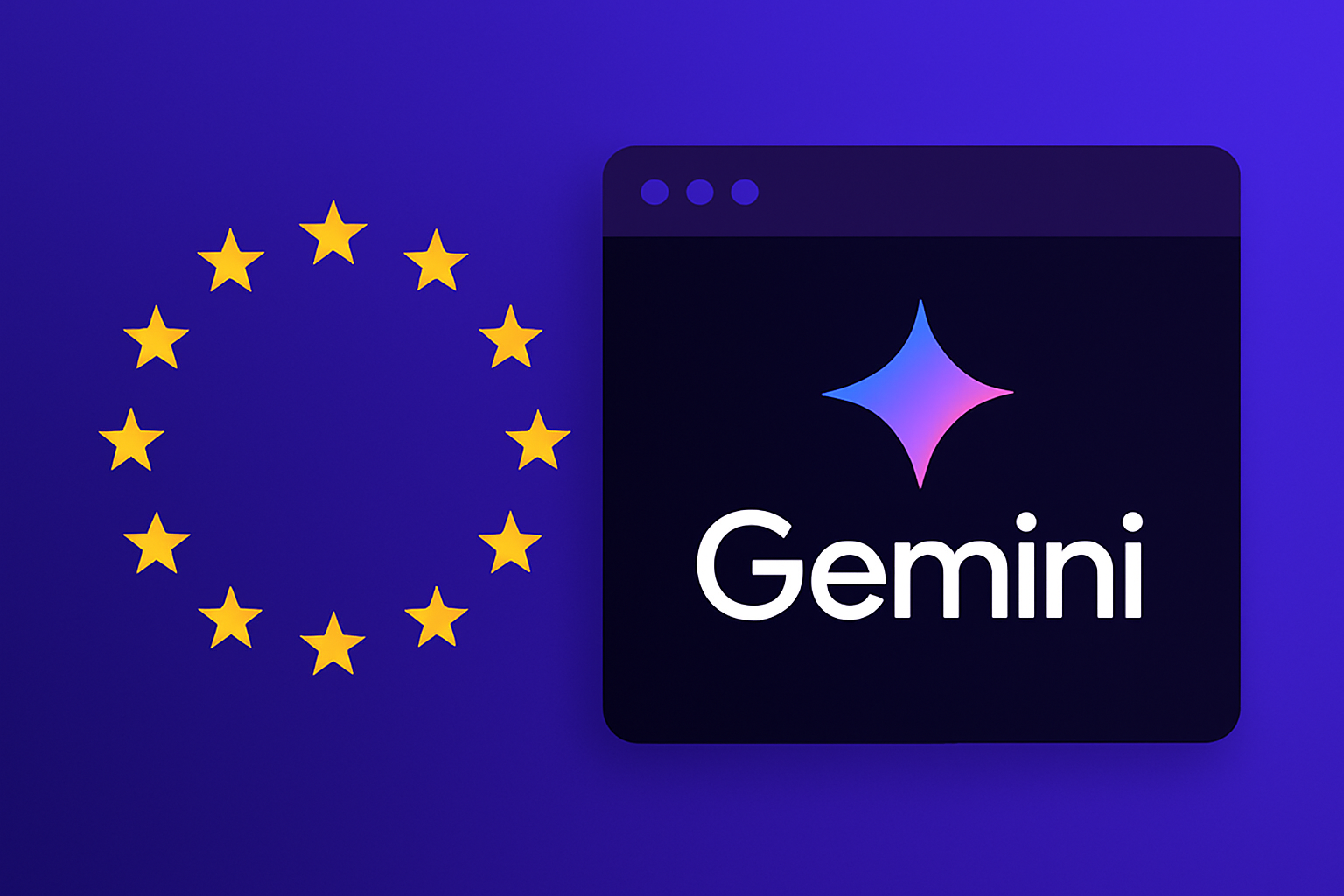
The European Commission has intensified its Digital Markets Act (DMA) push on Big Tech, turning fresh attention to how Google’s AI assistant Gemini interacts with Android and how Google Search data can be shared with rivals. Rather than launching a classic infringement case, Brussels has opened two targeted “specification proceedings” designed to clarify what Google must do in practice to comply with the DMA.
Announced on 27 January 2026, the move signals that the EU wants interoperability and data access obligations to work not just on paper, but in a way that allows competitors, including AI chatbot providers, to build viable alternatives. Google, for its part, argues that Android is already open and that it is already licensing Search data, while warning that added rules could harm privacy, security, and innovation.
1) What the EU just launched: two DMA “specification proceedings”
On 27 January 2026, the European Commission opened two DMA specification proceedings aimed at Google. The first focuses on Android interoperability tied to AI services “such as Gemini,” and the second concerns access to anonymised Google Search data for third parties, including potential eligibility for AI chatbots.
These actions are rooted in two key DMA provisions. For Android interoperability, the Commission is working under Article 6(7), which covers interoperability obligations for certain features and functionalities. For Search, the Commission is acting under Article 6(11), which addresses access to specific categories of search-related data on FRAND terms (fair, reasonable, and non-discriminatory).
The Commission’s own summary page explicitly highlights the Gemini angle and confirms the dual-track approach: specifying how third parties can gain equally effective access to Android features used by Google’s AI services and specifying how access to anonymised ranking, query, click, and view data should work in practice.
2) Why the Commission is pressing on Gemini access and Android interoperability
The EU’s framing is direct: if Google’s own AI services benefit from deep Android integration, third-party AI providers should be able to reach similar levels of integration under the DMA. The Commission says the goal is to ensure rivals have “equally effective access” to Android features used by Gemini so they can “innovate and compete” on mobile devices.
This matters because mobile operating systems are a critical distribution and capability layer for AI assistants. Access to system-level features, such as default settings hooks, background execution privileges, device sensors, or privileged APIs (depending on what the Commission deems “features used by Gemini”), can determine whether an assistant feels seamless or second-rate.
Regional reporting has summarized the practical implication bluntly: Google may need to remove barriers to rival AI systems and grant access comparable to what Gemini can leverage on Android. The Commission is not simply asking whether interoperability exists in principle, but whether it is effective and non-discriminatory in real-world conditions.
3) The second track: opening Google Search data, including for AI chatbot eligibility
Alongside Android/Gemini, the Commission is also specifying how Google must provide access to anonymised Google Search data under Article 6(11). The data categories cited in policy tracker summaries and Commission-aligned reporting include ranking, query, click, and view data, precisely the signals needed to tune relevance and improve search quality.
The EU’s stated objective is to make it feasible for competitors to build “genuine alternatives” to Google Search. The Commission argues that effective access to a useful dataset should help third-party search providers optimize their services and offer users meaningful choice, rather than symbolic competition.
A notable element is the Commission’s focus on conditions: the scope of data, the anonymisation method, and the access terms, specifically FRAND. Reporting also notes that the Commission is looking at access conditions and the eligibility of AI chatbots, reflecting how modern “search-like” experiences increasingly blend classic web search with conversational AI interfaces.
4) How a specification proceeding differs from a full DMA non-compliance case
Multiple news write-ups emphasize that this is the Commission “stepping in” through specification proceedings, which are short of a full investigation into non-compliance. In other words, the EU is not (yet) issuing a formal finding that Google has breached the DMA in these areas.
The Commission has been explicit that these proceedings “do not take a position on compliance” and are “without prejudice” to later steps. If the EU ultimately concludes that Google is not meeting clarified obligations, the Commission could still open non-compliance proceedings and, potentially, impose fines or periodic penalty payments.
This structure gives Brussels a way to turn high-level DMA duties into concrete, testable measures, especially in fast-moving domains like mobile AI, while keeping the enforcement pathway open if the clarified requirements are not implemented effectively.
5) Timeline and process: what happens over the next six months
The Commission has set a clear timetable. It aims to conclude the specification proceedings within six months of the 27 January 2026 opening, according to Commission communications and secondary policy trackers that summarize the process.
Within three months, the Commission expects to issue preliminary findings and draft measures. These will outline how Google should operationalize access, both for Android features relevant to Gemini-like services and for anonymised Search datasets shared on FRAND terms.
Transparency and stakeholder input are built in. Non-confidential summaries are expected to be published so third parties can comment, allowing rival AI providers, search competitors, researchers, and civil society groups to argue whether proposed access is genuinely “equally effective” and whether anonymisation and sharing terms are workable.
6) Google’s response: openness claims and privacy/security warnings
Google’s public reaction has stressed that it is already aligned with the direction of travel. In a statement attributed to Clare Kelly, Google’s Senior Competition Counsel, the company said: “Android is open by design, and we're already licensing Search data to competitors under the DMA.”
At the same time, Google has signaled resistance to any additional obligations that, in its view, go beyond what is necessary. In the same statement, Google warned: “However, we are concerned that further rules … will compromise user privacy, security, and innovation.”
That tension, between opening access for rivals and maintaining safeguards, will likely define the technical debates in both proceedings. On Android, the question will be what interoperability can be offered without creating new attack surfaces. On Search data, the question will be whether anonymisation and governance controls can prevent re-identification while still producing data that is valuable enough to power competitive services.
7) The broader EU narrative: competition, innovation, and AI market structure
The Commission’s actions fit a broader EU narrative that AI is a “profound technological shift” that could concentrate power if gatekeepers control the key inputs. Teresa Ribera, the Commission Executive Vice-President, was quoted describing the goal as to “maximize the potential and the benefits of this profound technological shift by making sure the playing field is open and fair, not tilted in favor of the largest few.”
By pairing Android AI interoperability (Gemini-linked) with Search data access, the Commission is targeting two strategic levers: distribution and capability on mobile devices, and the data needed to build competitive discovery and information services. Together, they shape whether new AI entrants can compete on quality and user experience rather than being structurally disadvantaged.
The DMA also allows Brussels to address these issues systemically rather than case-by-case. Instead of waiting for specific harms to crystallize, the Commission is trying to define “equally effective access” and FRAND data-sharing in a way that supports contestability across whole markets.
8) Context: rising scrutiny of Google’s AI practices in Europe
These specification proceedings do not exist in a vacuum. Separate reporting from 9 December 2025 described an EU investigation into Google’s use of online content for training AI models, including Gemini, an issue distinct from the DMA interoperability and Search data tracks, but indicative of wider regulatory attention.
Put together, the picture is of multi-front oversight: how AI systems are trained, how they are integrated into dominant platforms, and whether competitors can access essential interfaces and datasets. For Google, that means compliance is not just about one regulation, but about navigating overlapping expectations across competition, data governance, and digital regulation.
For the market, it suggests that “AI access” will increasingly be treated as a competition issue, covering not only model performance, but also defaults, integration privileges, and the information pipelines that shape user-facing services.
Over the next six months, the Commission will attempt to turn the DMA’s interoperability and data-access mandates into concrete requirements that can be measured and enforced. If the EU succeeds, rival AI assistants may gain deeper Android integration on terms comparable to Gemini, and alternative search and AI discovery services may obtain more actionable access to anonymised Search signals under FRAND conditions.
Whether this leads to more competition will depend on the details: what Android features are deemed essential, how “equally effective access” is defined, how anonymisation is implemented, and whether the resulting arrangements preserve user privacy and device security. The proceedings may not declare Google non-compliant today, but they set the rulebook that could determine how open the AI and search ecosystems in Europe become tomorrow.