

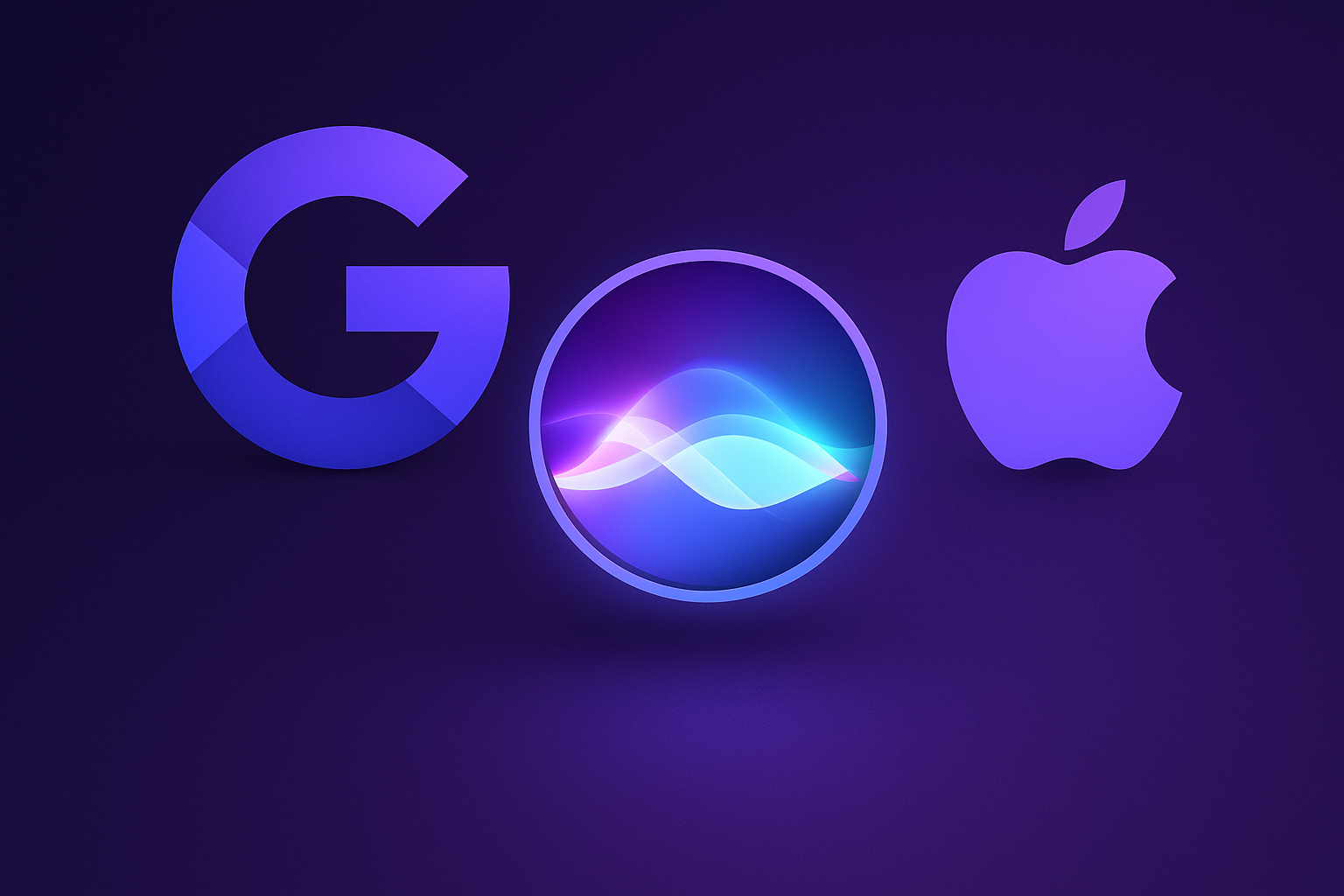
Apple and Google have confirmed a multi-year AI partnership that will put Google’s Gemini models at the core of Apple’s next wave of on-device and cloud-assisted intelligence. The line outcome is a revamped Siri, slated to roll out later in 2026, that becomes markedly more capable and more personalized, without Apple abandoning its privacy-first posture.
According to reporting from Reuters and analysis from The Verge, the agreement is also a strategic turning point in the broader AI platform race: Apple gains a fast path to frontier-grade model capability, while Alphabet lands one of the most valuable distribution wins imaginable, deep integration into Apple’s ecosystem. The companies frame the deal as “Gemini in Apple’s environment,” not Apple users “sent to Google.”
1) What Apple and Google Actually Announced
On 12 January 2026, Apple and Google announced a multi-year partnership in which Gemini models will underpin the next generation of Apple Foundation Models. In their shared messaging, the collaboration is positioned as the technical bedrock for a “more personalized Siri” and a broader set of Apple Intelligence features.
MacRumors relayed a key justification attributed to Apple’s evaluation process: “After careful evaluation… Google’s AI technology provides the most capable foundation…” In other words, Apple is publicly acknowledging that, on capability, Gemini offered the strongest baseline for what it wants Siri (and Apple Intelligence) to become.
Importantly, the scope is not limited to voice assistance. Coverage emphasizes that Gemini will help power “a range of future Apple Intelligence features,” suggesting the partnership is intended to influence multiple user-facing experiences, potentially across writing tools, summarization, search-like experiences, and system-wide actions.
2) Why This Is a Major Win for Alphabet, and a Calculated Move for Apple
Reuters described the deal as a major boost for Alphabet in the AI race, and the logic is straightforward: Siri is a default interface layer on hundreds of millions of devices. If Gemini becomes a core engine behind Siri’s reasoning and language capabilities, Google gains a powerful form of distribution that competitors struggle to match.
For Apple, the pact reads less like outsourcing and more like acceleration. Apple has strong incentives to keep the product experience, privacy story, and hardware/software integration under its own control, but it also faces pressure to close perceived gaps in assistant capability. Partnering lets Apple leapfrog years of model iteration and focus on orchestration, UX, and system integration.
The Verge notes Apple explored other AI partners before settling on Google. That detail matters: it implies a competitive bake-off rather than a foregone conclusion, reinforcing the idea that Gemini won on a combination of quality, deployability, and fit with Apple’s constraints, especially around privacy and on-device/cloud hybrid operation.
3) Timing: A Revamped Siri “Later in 2026”
Reuters reports that Gemini will be integrated into a revamped Siri later in 2026. While Apple did not necessarily commit to a single day-and-date in every region, the “later in 2026” framing suggests a staged rollout aligned with major OS releases and new device cycles.
This timing also indicates the work is not just model selection; it is product engineering. A more advanced Siri requires new safety layers, better tool access, revised user permissions, and updated UI affordances so users can understand what Siri can do, when it is acting, and what information it is using.
Because the announcement is multi-year, the first Siri upgrade may be only the start. A plausible interpretation is that Apple wants an evolving runway: initial Gemini-backed improvements in 2026, followed by iterative gains in planning, summarization, personalization, and multimodal interactions as Apple Intelligence expands.
4) How Gemini Powers Siri Without “Becoming Siri”
Reporting threads from late 2025 described an architecture where Siri’s overhaul includes planner, search, and summarizer components. In that depiction, Gemini contributes specifically to planning and summarization, core capabilities that make an assistant feel competent when it has to juggle steps, interpret context, and condense information.
The key product implication is that Siri becomes less of a single monolithic chatbot and more of an orchestrator that routes tasks to specialized modules. If Gemini is tasked with generating plans and producing high-quality summaries, Siri can handle complex multi-step requests more reliably while preserving Apple’s system-level control.
Just as important is where this runs. Coverage says Gemini operates within Apple’s environment (including Apple servers), which aligns with Apple’s desire to keep execution within its security model and to reduce the sense that Siri is merely a thin client for a third-party cloud bot.
5) Privacy Positioning: On-Device, Private Cloud Compute, and “No Data to Google”
Apple’s privacy narrative remains central. Post-announcement coverage emphasizes that Apple Intelligence processing continues to run on-device when possible, and otherwise through Apple’s Private Cloud Compute. The messaging is that Gemini runs in Apple’s environment rather than sending user prompts and personal data directly to Google.
Google, for its part, reportedly reinforced the assurance that user data is not handed over to Google as part of Apple Intelligence requests. That line is crucial for public trust: many users will accept “best-in-class model capability,” but only if it doesn’t come with a perceived trade of personal context for ad-tech profiling.
Still, the partnership will invite scrutiny. Even with private cloud controls, regulators and privacy advocates will ask for clarity on logging, retention, auditing, and incident response. Apple’s challenge will be to explain, in plain language, what information is processed where, and how users can control it.
6) Economics and Model Scale: The $1B/Year and “1.2T Parameters” Claims
Alongside the official statements, a widely repeated reporting thread (attributed in coverage to Bloomberg) claims Apple pays Google roughly $1 billion per year. While not confirmed in the public announcement, the figure has become part of the narrative because it signals how expensive frontier AI access and integration can be at platform scale.
The same thread describes a custom Gemini model at around 1.2 trillion parameters. Parameter counts are an imperfect proxy for performance, but they do convey ambition: Apple is not aiming for a modest upgrade, but for a top-tier assistant experience that can compete with the most advanced consumer AI systems.
These economics also hint at why Apple would pursue a multi-year deal. AI partnerships require ongoing tuning, new infrastructure, and continuous safety work. A long-term contract can lock in capacity, align roadmaps, and provide predictable access to model improvements, especially when user expectations will rise quickly after launch.
7) Antitrust Backstory and the Long Negotiation Trail
The partnership did not appear overnight. In an antitrust context, Google CEO Sundar Pichai had previously suggested hopes for an Apple-Gemini agreement by mid-2025 during testimony. That timeline implies the companies were discussing technical and commercial terms well before the January 2026 confirmation.
The antitrust angle matters because Apple and Google already have a high-profile relationship through search distribution arrangements. Any deepening of ties, especially one that touches a core interface like Siri, will likely be examined for competitive impact, platform leverage, and potential lock-in effects.
From Apple’s standpoint, partnering with Google in AI is a pragmatic move, but it must be balanced against the risk of appearing dependent on a major rival. The multi-year structure suggests Apple believes it can preserve strategic autonomy by keeping the product layer and privacy stack firmly under its control.
8) Backlash and the “Concentration of Power” Critique
Public reaction has been mixed, and criticism from Elon Musk quickly became part of the story, with comments framing the tie-up as an “unreasonable concentration of power for Google.” While Musk is a polarizing figure, the underlying concern resonates: a small number of companies increasingly supply the models that power everyone else’s experiences.
This critique is not just philosophical. If a single model family underpins many assistants and apps, mistakes, biases, or security flaws can propagate widely. It also raises questions about pricing power, innovation diversity, and how easily ecosystems can switch partners if relationships sour.
Apple’s likely rebuttal is architectural: Gemini is a foundation, not a takeover; Apple is still controlling the interface, the device integration, and the privacy boundary. Whether that distinction satisfies skeptics may depend on transparency, what Apple publishes about data flows, model behavior, and user choice.
Ultimately, “Gemini powers Siri in Apple-Google pact” is less a novelty line than a sign of where the AI market is ing: toward alliances that combine distribution, hardware, and frontier model capability. Apple is betting it can integrate Gemini deeply while still making Siri feel distinctly “Apple”, private, seamless, and system-aware.
If the 2026 rollout delivers a more competent planner and summarizer, with clear privacy guarantees and real day-to-day usefulness, users may remember this as the moment Siri caught up. If it stumbles, on trust, transparency, or quality, it will amplify concerns about concentrated AI power and the risks of building essential interfaces on someone else’s models.