Iterative RAG is reshaping how we think about retrieval-augmented generation in latency-sensitive, accuracy-critical applications. By alternating reasoning steps performed by large language models with targeted retrieval actions, iterative approaches trade extra compute and retrieval work for higher factual fidelity and better multi-hop reasoning.
Recent literature and industry launches have pushed iterative patterns toward real-time settings: streaming inputs, dynamic vector stores, and tunable decoding strategies make it possible to get substantially better accuracy without sacrificing the responsiveness required by production services. Below we unpack the key ideas, recent advances, engineering patterns, and remaining challenges.
What is Iterative RAG and why it matters
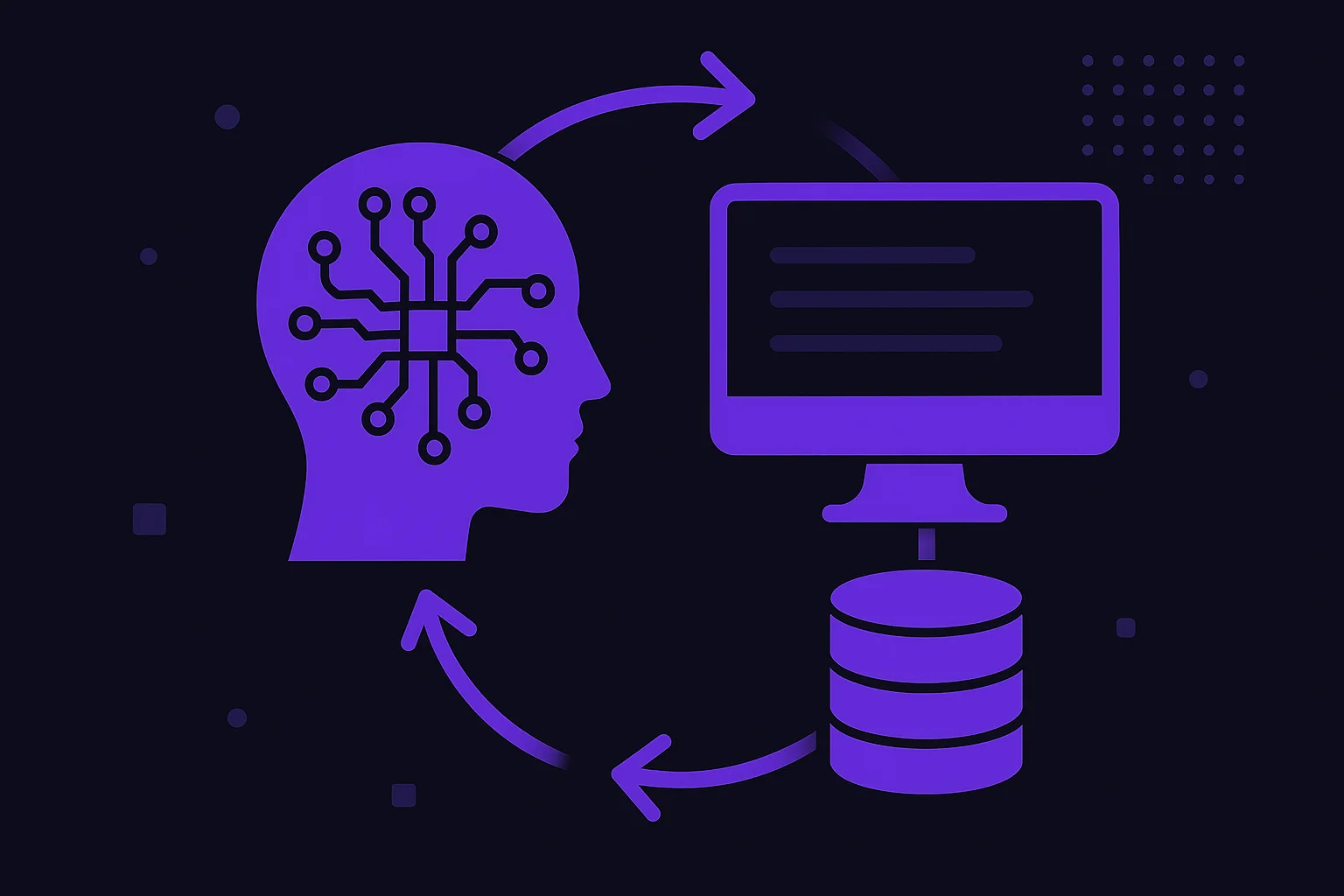
Iterative RAG, sometimes called iRAG or chain-of-retrieval RAG, extends classic RAG by inserting one or more retrievals between LLM reasoning steps. The model reasons, reformulates queries or extracts sub-queries, retrieves new evidence, and then continues reasoning. This loop reduces hallucination and supports multi-hop queries by explicitly grounding intermediate conclusions.
The core trade-off is explicit: extra retrievals and inference steps increase latency and cost, but they often produce single-digit to double-digit improvements in metrics like EM, F1, and Recall@k on knowledge-intensive benchmarks. Papers such as CoRAG report more than 10 points improvement in exact match for multi-hop QA relative to strong baselines, making the technique attractive for tasks where correctness matters more than the last millisecond of latency.
Beyond accuracy, iterative designs improve interpretability. By surfacing intermediate queries or retrieval chains, systems provide evidence trails that operators can inspect. That transparency helps debugging, evaluation and governance when the stakes are high.
Recent academic advances driving accuracy
Several 2024, 2025 works demonstrate how iterative retrieval variants unlock gains on established benchmarks. CoRAG (Chain-of-Retrieval Augmented Generation) trains models to generate retrieval chains and offers decoding knobs to trade compute for accuracy, establishing new SOTA on KILT-style tasks in the authors' experiments.
Other papers pursue different angles: IterKey uses LLM-driven iterative keyword generation to boost sparse BM25 retrieval, reporting meaningful gains and arguing for better interpretability versus dense retrievers. KiRAG decomposes documents into knowledge triples, iteratively retrieving and showing improvements in recall and F1 on multi-hop datasets.
StreamingRAG and related work add temporal and multimodal dimensions: evolving knowledge graphs and incremental retrieval mechanisms yield throughput and resource-efficiency wins while keeping grounding fresh across a stream of inputs. Across these papers the consistent message is that guided iteration, whether via query reformulation, KG guidance or streaming state, improves grounding for complex queries.
Real-time infrastructure: vector stores, disk indices, and managed engines
Bringing iterative RAG to real-time production requires matching algorithms to infrastructure. Vendors and open-source projects have advanced dynamic vector indices, semantic caches, and managed RAG pipelines to reduce retrieval latency and support continuous updates. Redis' vector sets and LangCache, for example, aim for sub-millisecond or low-ms vector queries with instant updates that suit live RAG systems.
Disk-based approaches like LSM-VEC show how to keep billion-scale corpora mutable without blowing memory budgets, reporting large memory reductions and lower update latencies versus earlier disk ANN techniques. For many streaming or high-ingest scenarios, a disk-backed index that supports fast inserts and deletes is a key enabler of iterative, real-time retrieval.
Managed offerings, Cloudflare AutoRAG and Google Vertex AI RAG Engine, bundle ingestion, continuous indexing, and runtime grounding. AutoRAG highlights continuous background indexing and response streaming, while Vertex AI RAG Engine exposes pluggable vector stores and runtime plumbing for freshness and enterprise integrations, lowering the operational bar for production RAG.
Practical trade-offs: latency, compute, and tunable iteration
Iterative RAG is not a one-size-fits-all solution. Papers and vendor docs consistently emphasize tunable decoding and retrieval depth so practitioners can select a latency/accuracy point on the spectrum. CoRAG and similar works describe greedy, best-of-N, and beam/tree strategies that let teams budget compute at inference time.
For strict-latency use cases, common engineering patterns are to limit the number of iterations, use strong rerankers, employ semantic caches to reuse recent results, or move heavier retrieval work to background precomputation. ComRAG reports concrete runtime savings and reduced chunk growth through smarter iterative updates, illustrating how system design can mitigate iteration costs.
Another practical lever is hybrid retrieval: combine sparse retrievers (fast, interpretable) with selective dense rerankers, or use embedding-less iterative text exploration (ELITE) to reduce storage while still aligning retrieval to user intent. The result is a palette of knobs, iterations, reranking, caching, and store selection, that teams can tune for their SLA and budget.
Safety, governance, and security in iterative pipelines
Iterative RAG amplifies governance needs because retrieval loops can expand the attack surface. Centralized vector stores, while performant, raise concerns about permission bypass and data exfiltration if access controls are not carefully applied. Industry commentary points out why some organizations are exploring agentic alternatives that query source systems at runtime to preserve original authorization semantics.
Managed RAG products and research papers address these risks with audit trails, streaming filters, permission-aware retrieval, and instructionable rerankers. Semantic caching strategies and access-aware filters can reduce repeated hits on sensitive sources while maintaining freshness, but they require clear policies and observability to be effective.
Open problems remain: iterative retrieval drift (where reasoning chains become irrelevant), balancing frequent updates against recall loss, and ensuring updatable large-scale indices respect origin-system controls. Proposed mitigations include KG-guided retrieval, rejection-sampling training, and disk indices designed for mutable data, but deploying these in production still requires careful threat modeling and governance work.
Agentic hybrids and the industry pivot
There is a growing trend toward agent-based or multi-agent hybrid architectures that combine iterative retrieval with planner, extractor, and reranker agents. These MA-RAG or agentic RAG systems aim to preserve runtime flexibility, enforce source permissions, and orchestrate complex multi-step interactions while retaining the accuracy benefits of iterative grounding.
Some industry voices argue that traditional RAG is being supplanted by these agentic approaches because agents can query multiple systems live and adhere to per-source authorization, making them appealing for enterprises that must preserve auditability and fine-grained access. The reality is often mixed: many deployments use managed RAG engines or vector stores for performance, but layer agentic control planes on top for governance-sensitive workflows.
In practice, hybrid designs that combine iterative retrieval for accuracy with agentic orchestration for control offer a pragmatic path: let iterative RAG provide better grounding, while agents manage task planning, source access, and policy enforcement at runtime.
Deployment patterns and real-world results
Real-world deployments already demonstrate the value of RAG at scale. For instance, InfoQ reported that Uber's Genie RAG-based copilot answered tens of thousands of queries and saved substantial engineering time, showing how grounding monetizes directly in productivity metrics. Cloud vendors and platform products have similarly framed RAG as a production-ready pattern for enterprise assistants and knowledge services.
Empirical gains from iterative variants on benchmark tasks vary but are meaningful: single-digit to double-digit improvements are common across CoRAG, IterKey, KiRAG and ComRAG papers, often concentrated on multi-hop QA. ComRAG in industry-focused work also measured vector-similarity improvements and latency reductions under dynamic update workloads, indicating iterative designs can be optimized for throughput and freshness.
Benchmarks and reproducibility notes matter: many results are reported on multi-hop QA suites, KILT, and BEIR-style datasets. Teams should compare datasets and reported metrics to their production distributions before extrapolating; tuning the number of iterations, reranker strength, and cache strategies is usually required to replicate lab gains in the wild.
Open problems and research directions
Despite promising progress, several open problems persist. Iterative retrieval drift and hallucination remain concerns: LLMs can propose plausible but incorrect subqueries or chains. Limiting iterations, using stronger evidence verification, and KG-guided retrieval are active research directions to mitigate drift.
Scalability and index mutability are also urgent: how to maintain high recall with frequent inserts/deletes at billion-scale remain an engineering frontier. Disk-friendly, mutable indices like LSM-VEC and smarter chunking strategies are important steps, but more work is required to make these techniques transparent and robust for ops teams.
Finally, integrating privacy-preserving access controls and fine-grained governance into high-performance stores is an area where research, product and policy must converge. Practical deployments will likely blend managed platforms, agentic control planes, and engineering safeguards to balance accuracy, throughput and security.
Iterative RAG is not a silver bullet, but it is a powerful evolution of RAG that intentionally trades compute for grounding and higher factual accuracy. With new papers and product launches from CoRAG to AutoRAG, IterKey, KiRAG and StreamingRAG, the community now has practical blueprints for improving multi-hop QA, streaming assistants, and real-time knowledge systems.
For teams considering iterative RAG, the advice is pragmatic: start with clear accuracy goals, measure latency and cost trade-offs, and adopt incremental iteration strategies, use selective iterations, strong rerankers, and semantic caches. Combine managed RAG engines or robust vector stores with governance layers or agentic controls where needed, and treat reproducibility and benchmark comparisons as essential steps before production rollouts.