

Automating content operations is no longer just about publishing faster. For teams working on answer engine optimization, or AEO, the real goal is to build a pipeline that consistently produces useful, trustworthy, technically accessible content that can surface in modern AI-driven search experiences. An AEO-ready content pipeline must therefore balance automation with editorial judgment, structured data, and measurable performance feedback.
Recent guidance from Google makes this especially clear. There are no special requirements for appearing in AI Overviews or AI Mode; the same core SEO fundamentals still apply, including technical accessibility, policy compliance, and helpful, reliable, people-first content. At the same time, new Search Console reporting for generative AI visibility gives content teams a practical way to monitor how their pages perform in these experiences and improve iteratively.
Start with people-first content, not AI-first publishing
Google’s guidance on AI search repeatedly emphasizes that teams do not need a separate playbook for AI Overviews or AI Mode. Instead, they should continue following core best practices: make content crawlable, maintain high technical quality, comply with policies, and focus on serving real users. That means the foundation of any automated workflow is still editorial usefulness, not prompt volume.
This matters because Google’s helpful-content guidance explicitly warns against extensive automation when it is used to create search-engine-first material. In practice, that means automation should support research, drafting, formatting, and quality control rather than enabling low-value mass publishing. If a pipeline scales production without improving substance, it increases risk instead of increasing visibility.
Google’s May 2025 AI Search guidance reinforces this standard by prioritizing unique, satisfying content over commodity content. An AEO-ready workflow should therefore be designed to produce original value: firsthand expertise, differentiated analysis, better examples, clearer explanations, or stronger synthesis. The automation layer should help teams deliver that uniqueness consistently, not flatten every page into the same generic template.
Design the pipeline around source-backed, structured workflows
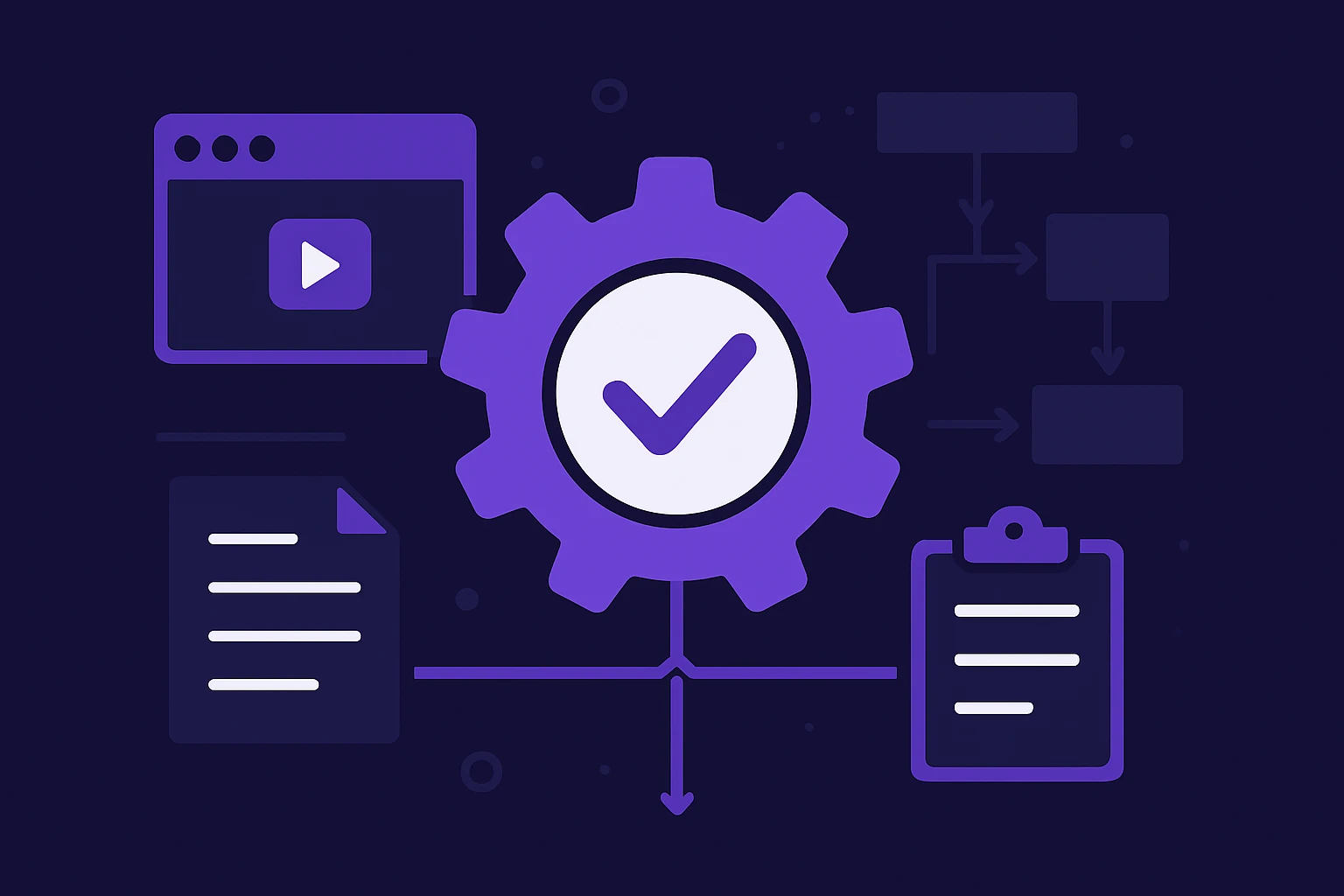
A practical content system should move through clear stages: ideation, source collection, source-backed drafting, structured data generation, compliance checks, title and summary review, and post-publication measurement. This sequence aligns well with both Google’s people-first guidance and modern API-based automation. It also creates control points where editors can verify accuracy and usefulness before publication.
OpenAI’s Responses API supports this style of multi-step workflow because it is built for more than one-shot generation. With tools such as web search, file search, and computer use, developers can create pipelines that gather information, extract structured facts, transform them into drafts, and pass validated outputs into publishing systems. That makes it easier to operationalize repeatable content production without sacrificing process discipline.
For AEO, the strongest pattern is human-guided and schema-driven. Teams can define what each content asset must contain, such as target query clusters, source notes, entity references, summary blocks, FAQ candidates, and metadata fields. Once those requirements are structured, the system becomes easier to automate safely because every step can be validated against expected inputs and outputs.
Use schema-constrained generation for consistency
One of the biggest challenges in automated publishing is getting reliable machine-readable outputs. OpenAI’s Structured Outputs feature addresses this by constraining model responses to developer-supplied JSON Schemas. For content operations, that is highly useful because briefs, outlines, FAQs, summaries, schema fields, and QA checklists can all be generated in consistent formats that downstream systems can ingest automatically.
OpenAI has said Structured Outputs achieved 100% schema adherence in its evals for complex JSON schema following. That is important for deterministic assembly workflows, where one missing field can break a publishing job or create malformed metadata. It also reduces the operational over associated with manually fixing inconsistent outputs from free-form generation.
OpenAI’s help documentation further recommends using Structured Outputs or validation plus retries whenever output must match a schema. In an AEO-ready pipeline, that principle can be applied across the full workflow: extract entities into fixed fields, generate summary variants in known structures, produce FAQ blocks with exact key-value formatting, and ensure schema markup payloads can be programmatically checked before they ever reach production.
Automate structured data carefully and keep it aligned with visible content
Structured data still matters for content discoverability, but Google’s guidance is clear that teams should not overfocus on it as if markup alone can unlock AI visibility. Schema helps search systems interpret a page, yet it is not a substitute for genuinely helpful content. In other words, structured data is an amplifier of clarity, not a replacement for quality.
Google’s July 2026 structured data guidance is especially relevant for automated pipelines: structured data must match the visible page content and comply with applicable content policies. This is a critical governance rule for any workflow that auto-generates schema from content blocks. If the visible page says one thing and the markup says another, the automation is creating risk rather than operational efficiency.
For article pages, Google recommends adding as many relevant recommended properties as apply, even though there are no required properties. That creates a practical opportunity for enrichment automation. A pipeline can reliably populate fields such as line, author, date published, date modified, and image metadata, provided those details are also present on the page itself and verified during QA.
Build title and summary generation around accuracy first
Titles and summaries play a major role in both traditional search and AI-assisted discovery. Google Discover guidance recommends lines that capture the essence of the content and specifically warns against clickbait. For AEO-ready publishing, this means the title-generation step should prioritize clarity, specificity, and factual alignment over exaggerated hooks.
A good operating principle is accurate first, optimized second. Search visibility is important, but titles should still reflect what the page actually delivers. The same logic applies to summaries, dek lines, and FAQ-style answer blocks. If these elements overpromise, sensationalize, or flatten nuance, they may attract the wrong clicks and undermine long-term trust.
Automation can support this stage by generating several compliant options and then scoring them against editorial rules. For example, a pipeline can check whether a title includes the core topic, whether it mirrors the article’s true scope, whether it avoids clickbait phrasing, and whether the summary remains concise and non-sensational. Human review then becomes a focused quality decision rather than a manual drafting burden.
Measure AEO visibility with Search Console feedback loops
One of the most important recent developments for AEO operations is Google’s June 2026 Search Console update introducing dedicated generative-AI performance reports for AI Overviews and AI Mode. This gives content teams a direct feedback loop for understanding which pages are being surfaced in these environments. Instead of guessing whether content is visible in AI search experiences, teams can now monitor performance in a more segmented and actionable way.
This changes how an automated content pipeline should be designed. Search Console monitoring should be built into the operating model from the start, not treated as an optional analytics step after publication. If pages are receiving impressions in AI features but low click-through, teams may need stronger titles, sharper summaries, better on-page differentiation, or clearer next-step value for users.
Because Google’s AI-related documentation and reporting methodology continue to evolve, AEO measurement should be treated as a moving target. Search Central updates in 2026 show that guidance around AI Overviews, AI Mode, and website visibility can change quickly. A mature pipeline therefore includes ongoing reporting reviews, taxonomy updates, and experimentation cycles instead of assuming that one configuration will remain effective indefinitely.
Optimize for clicks, citations, and follow-through
Google’s AI search guidance notes that AI experiences are designed to surface links that help people explore the web, not replace it. That is an important strategic point for publishers. AEO is not just about being summarized by a system; it is about earning the visit that follows the summary, citation, or recommendation.
As a result, content teams should structure pages so they reward click-through behavior. That can include concise answer blocks near the top, followed by richer detail, examples, visuals, comparisons, and practical next steps that make the full page worth visiting. If the page offers only what could fit into a short summary, it becomes easier for users to stop at the AI layer.
An automated pipeline can support this by assembling modular content formats that are strong both for answer extraction and for deeper consumption. For instance, the system can generate executive summaries, expandable explanations, key takeaways, examples, and implementation steps in separate blocks. This helps the page serve multiple user intents while preserving a clear, high-value reason to click and continue reading.
Put governance at the center of automation
The safest model for scaling AEO content is not full autonomy but governed automation. Human editors should define source standards, approve templates, review sensitive claims, and oversee publishing thresholds. Automation should handle repeatable production tasks, while people remain accountable for truthfulness, originality, and audience value.
This is where schema-driven workflows are especially useful. When every stage has explicit requirements, teams can run compliance checks before publication: Are all factual claims source-backed? Does the structured data match visible content? Are required author and date fields present? Does the title reflect the article’s actual scope? Is the content materially distinct from existing commodity pages? Governance becomes operational rather than aspirational.
In practice, the best AEO-ready content pipeline is one that combines structured generation, human review, and measurable search outcomes. It does not chase shortcuts or assume that AI visibility can be engineered through markup alone. Instead, it creates a disciplined system for producing original, machine-readable, user-centered content that can adapt as search ecosystems continue to change.
Automation can absolutely strengthen content operations, but only when it is used to improve quality, consistency, and speed at the same time. The most durable approach is to automate production mechanics while preserving editorial judgment where it matters most. That keeps the pipeline aligned with Google’s people-first guidance and reduces the temptation to scale low-value output.
For teams investing in AEO, the opportunity is not just to publish more pages. It is to build a repeatable workflow that turns trusted sources into helpful articles, valid structured data, accurate titles, and measurable performance improvements. With schema-constrained generation, visible-content alignment, and Search Console feedback loops, automated content systems can become far more reliable and far more effective.