


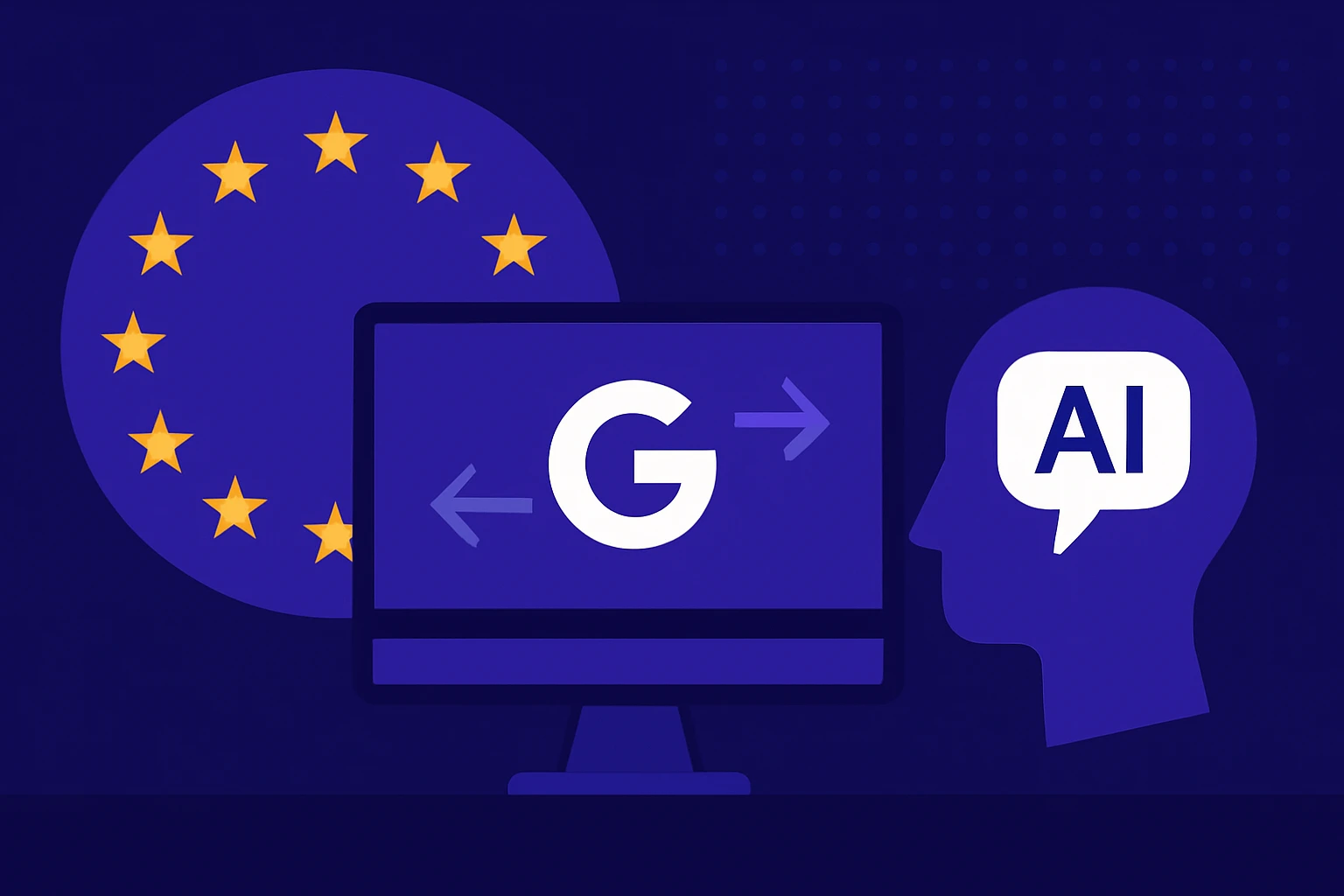
The European Union has taken a significant new step in its campaign to regulate dominant digital platforms, this time focusing directly on Google’s control over search data. Under fresh guidance issued by the European Commission in July 2026, Google will be required to share anonymized search information with qualifying rivals, including both traditional search engines and AI-powered services that include search functionality. The decision marks one of the clearest signs yet that European regulators see access to data as central to competition in the modern internet economy.
The move is rooted in the Digital Markets Act, or DMA, which was designed to curb the power of so-called gatekeepers. In the EU’s view, Google’s dominance in search has long given it a structural advantage that is difficult for competitors to overcome. By ordering the company to open parts of its search data on fair, reasonable, and non-discriminatory terms, the Commission aims to lower barriers to entry, encourage innovation, and expand consumer choice across both search and AI markets.
A landmark EU decision under the Digital Markets Act
The Commission’s July 2026 guidance formally tells Google to share anonymized ranking, query, click, and view data with eligible third-party online search engines. This requirement comes under Article 6(11) of the DMA, which specifically obliges gatekeepers operating search engines to provide access to certain data on FRAND terms. In practical terms, the EU is not simply asking Google to be more open in spirit; it is defining a legal compliance obligation with operational consequences.
This matters because search data is one of the most valuable assets in the digital economy. It reflects user intent, patterns of discovery, and engagement signals that help improve ranking models, relevance systems, and product design. Regulators have concluded that if only one dominant player controls this feedback loop at massive scale, competition becomes distorted over time, no matter how talented or well-funded rivals may be.
The decision also reflects how the DMA is evolving from a broad legislative framework into a set of concrete enforcement tools. Earlier in April 2026, the Commission opened proceedings to specify exactly how Google should comply and how beneficiaries would be selected. The July guidance turns that process into a practical roadmap, making clear that the law will be used not just to punish misconduct after the fact, but to proactively reshape market conditions.
Why Google search data matters so much
The Commission has described data as a “key input” for online search and for the development of new digital services, including AI. That language is important because it frames search data not as a secondary business asset, but as core infrastructure for innovation. If regulators believe data is an input like electricity, bandwidth, or computing power, then restricting access to it can be seen as restricting competition itself.
Search ranking, queries, clicks, and views each reveal something different about how people use the web. Ranking data can help competitors understand result ordering and relevance patterns. Query data offers insight into what users are looking for, click data indicates which results people choose, and view data can provide a broader picture of what content is being surfaced. Taken together, these signals can improve everything from search accuracy to AI answer generation.
For years, Google’s lead in search has been strengthened by this self-reinforcing cycle: more users generate more data, more data improves results, and better results attract even more users. The EU’s intervention is designed to interrupt that cycle just enough to give other players a realistic chance to compete. Regulators are effectively arguing that without some data portability at scale, meaningful rivalry in search and AI may remain out of reach.
AI rivals are now explicitly part of the picture
One of the most notable aspects of the new rules is that they do not apply only to classic search competitors. The Commission has explicitly said that beneficiaries can include “AI chatbots with search functionalities.” That wording broadens the scope of the measure and acknowledges a major change in how users access information online: the line between search engine and AI assistant is rapidly fading.
This inclusion has strategic importance. AI systems that answer questions, summarize sources, and help users navigate the web increasingly rely on search-like capabilities. By recognizing AI chatbots as eligible recipients of anonymized search data, the EU is effectively stating that future competition will not be limited to ten blue links and traditional search result pages. It will also play out in conversational interfaces and hybrid discovery tools.
Reuters reported that the EU requirements would force Google to help OpenAI and other AI rivals, alongside search competitors, access Google services and search data. That framing underscores how seriously regulators are taking the competitive implications of generative AI. Rather than waiting for AI markets to consolidate around a few dominant ecosystems, the Commission appears determined to act early and shape the foundations of the sector.
The January 2027 deadline and compliance pressure
The new obligations are not open-ended or purely aspirational. Reporting on the Commission’s July 16, 2026 decision indicates that Google must begin sharing anonymized search data with some rivals by January 2027. That timeline gives the company only a limited window to design systems, vet recipients, set technical standards, and establish terms that satisfy regulators.
Meeting the deadline will likely require substantial engineering and legal work. Google will need to determine how to anonymize sensitive information effectively while still delivering datasets useful enough to support rival services. It will also need to build processes for onboarding eligible beneficiaries and ensuring that access terms are fair, reasonable, and non-discriminatory in practice, not just in theory.
From the EU’s perspective, a firm deadline is essential. Competition remedies often lose force when implementation is delayed by procedural complexity or prolonged negotiation. By setting January 2027 as the start date, the Commission is signaling that compliance should produce tangible market effects within a foreseeable period, rather than becoming a slow-moving regulatory aspiration.
How the EU says competition and consumers will benefit
The European Commission argues that opening access to Google Search data should help both established competitors and credible new entrants “spark innovation and broaden choice.” This is a classic competition-policy objective, but it takes on new urgency in search and AI, where scale advantages can quickly become entrenched. If rival firms gain access to critical data inputs, they may be better positioned to improve relevance, create new formats, and serve niche or underserved audiences.
For consumers, the promise is more options and potentially faster product improvement. A healthier competitive environment could lead to better specialized search engines, stronger privacy-focused alternatives, and more capable AI assistants that are not tied to a single dominant platform. In theory, users would benefit not just from lower switching costs, but from a wider range of approaches to finding and interpreting information online.
Of course, success is not guaranteed. Simply giving competitors access to anonymized search data does not automatically create viable alternatives to Google. Rivals still need capital, engineering talent, distribution, and trust. Yet the Commission’s position is that without this baseline access, many of those competitors would never get a fair chance to test their ideas at meaningful scale.
Part of a broader European push on Google’s ecosystem
The search-data-sharing order does not stand alone. The same July 2026 guidance also addressed Android AI interoperability, showing that regulators are looking at Google’s power across interconnected layers of its ecosystem. Search, mobile operating systems, browsers, AI assistants, and app distribution all influence one another, and the EU appears increasingly unwilling to regulate these domains in isolation.
This broader approach reflects a concern that competition can be weakened not only by dominance in one product, but by the integration of multiple services that reinforce each other. If Google controls how users search, which mobile defaults they encounter, and which AI services are deeply embedded into devices, then rivals may struggle even if they are strong in one area. The Commission’s guidance suggests it wants emerging alternatives not just to Google Search, but also to Google’s AI offerings such as Gemini.
That is why many observers are framing the ruling as a blow to Google’s dominance. It is not merely about a narrow dataset-sharing obligation. It is part of a wider effort to loosen the grip of a powerful ecosystem and make room for more independent innovation. In Europe’s regulatory vision, interoperability and data access are becoming central tools for preventing digital markets from closing around incumbent platforms.
The challenges and likely debates a
Even with a formal legal basis and a deadline in place, the implementation of this measure will almost certainly be contested. Questions will arise over who qualifies as an eligible beneficiary, how useful the shared data will be after anonymization, and whether Google’s terms truly meet the FRAND standard. The April 2026 proceedings were launched in part to define these issues, but practical disputes are likely once the system moves from paper to execution.
There will also be a broader policy debate about balancing competition with privacy, security, and commercial incentives. Regulators insist the data must be anonymized, which is intended to reduce privacy concerns. Still, the effectiveness of anonymization, the risk of data misuse, and the need for robust safeguards will remain under scrutiny, especially given the sensitivity and scale of search behavior.
Another open question is whether the remedy will materially shift market shares or mainly improve the capabilities of smaller players at the margins. Some critics may argue that access to Google search data is not enough to offset the company’s brand recognition, default positions, and infrastructure advantages. Supporters, however, will counter that structural competition policy is rarely about instant disruption; it is about removing barriers so that alternatives can emerge over time.
The EU’s order for Google to share search data with AI rivals and search competitors represents one of the most consequential digital competition interventions in recent years. By explicitly including AI chatbots with search functionality and setting a January 2027 deadline, the Commission has made clear that it sees the future of competition as extending beyond traditional search into the fast-changing world of AI-powered information services.
Whether the measure ultimately transforms the market will depend on the details of implementation and the willingness of rivals to capitalize on the opportunity. But the broader message is unmistakable: the European Union believes that data access is essential to contestability, and that dominant platforms cannot be allowed to keep critical inputs entirely to themselves. In that sense, the ruling is not just about Google. It is a statement about how Europe wants the next era of search and AI to be built.