

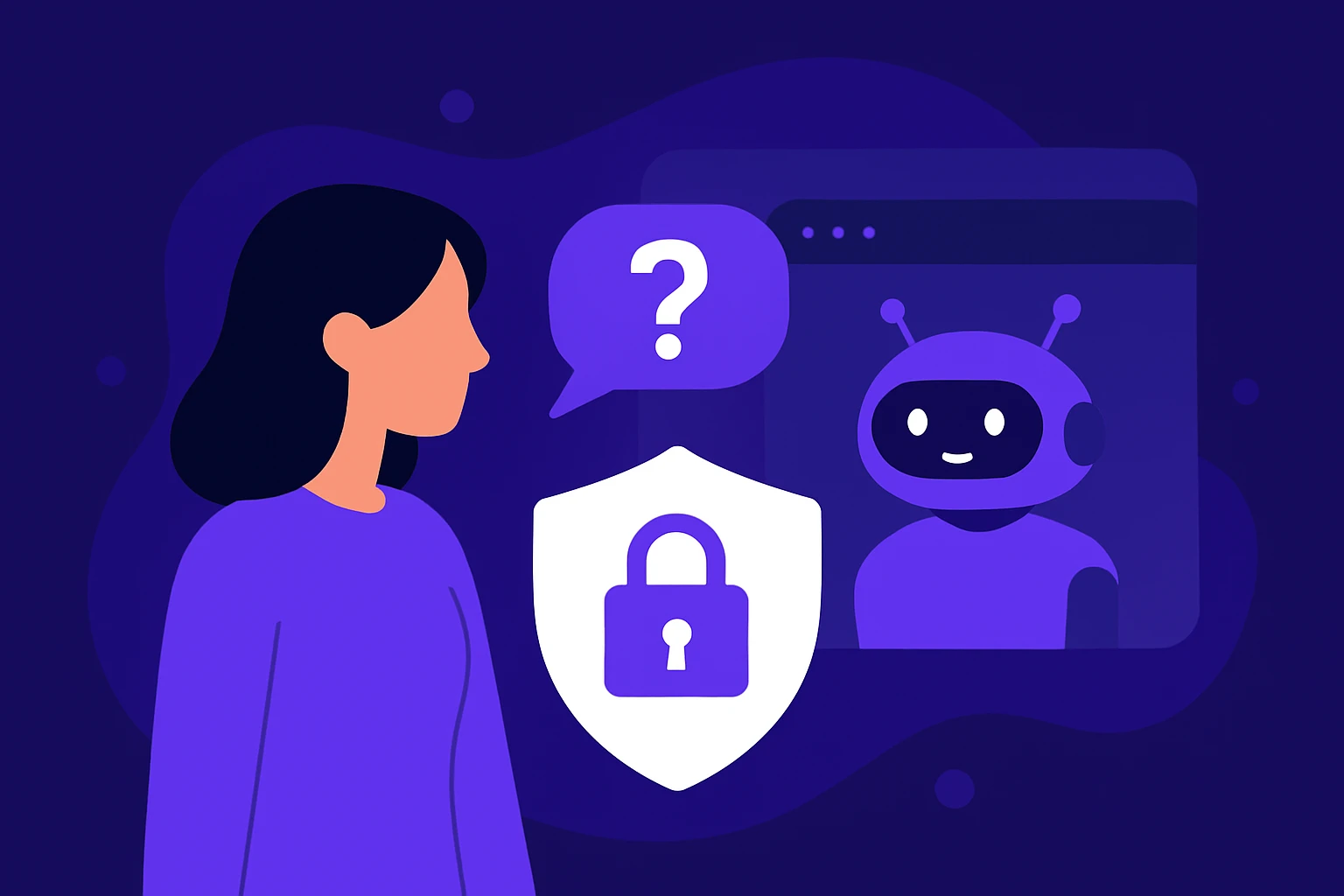
Artificial intelligence is increasingly becoming a daily assistant, but one question matters more than ever: where does your data go when you ask for help? A growing number of technology companies are now promoting a model in which AI works locally first and only reaches the cloud when necessary. In the best versions of this approach, the system does not silently ship everything away. Instead, it asks before sending data, or at least limits and documents what leaves the device.
This shift is important because it changes the relationship between users and intelligent software. Rather than assuming that cloud processing is the default, newer architectures emphasize local AI, selective routing, user permission, and visible safeguards. Across recent announcements from Apple, Perplexity, Google, and Microsoft, a shared pattern is emerging: keep routine processing on the device, escalate only harder tasks, and add privacy controls before anything sensitive is sent elsewhere.
Why local-first AI matters
Local-first AI means the initial work happens directly on your phone, laptop, or other personal device. That matters because data that never leaves the device is generally easier to protect, faster to process, and less exposed to third parties. For users, this can turn privacy from a vague promise into a concrete technical design choice.
This model also improves trust. People are often comfortable letting AI summarize notes, rewrite text, or organize personal information if they know those operations are happening locally. The concern begins when a request is transferred to distant servers without a clear explanation. A system that asks before sending data gives the user a more active role in deciding what happens next.
The idea is not to eliminate the cloud entirely. Advanced reasoning, large model inference, and complex multi-step tasks may still require remote infrastructure. The difference is that local AI treats the cloud as an exception or an extension, not the automatic first destination for every prompt.
Perplexity’s portable computer shows the pattern clearly
One of the clearest recent examples comes from Perplexity’s portable computer, as reported by Tom’s Guide. The system is described as local-first AI that runs on your PC for ordinary tasks. If a job requires stronger reasoning, it does not simply pass everything to a frontier model in the cloud behind the scenes.
Instead, it asks permission before sending that individual step to the cloud. That detail is significant because it introduces step-level consent rather than broad one-time acceptance. In practice, this means a user can benefit from local speed and privacy for most interactions while still unlocking more advanced capabilities only when needed.
This design captures the growing appeal of local AI asks before sending data. It gives users a visible checkpoint between private on-device work and external processing. That checkpoint may become one of the defining trust features of next-generation AI products.
Apple’s on-device-first strategy goes further
Apple has made perhaps the most detailed public case for this privacy model. The company says many Apple Intelligence features run entirely on-device, while more complex requests can use Private Cloud Compute. In other words, the default is local processing, and the cloud becomes a secondary path for tasks that exceed what the device can do alone.
Apple’s support materials explain that with Private Cloud Compute, only data relevant to the request is processed on Apple silicon servers and then removed. The company also says device attestation occurs before a request is sent. These details matter because they show that routing to the cloud is not treated as a casual handoff, but as a controlled event with technical verification.
Apple’s security documentation adds another layer by saying Private Cloud Compute is designed so personal user data is not accessible even to Apple, and that requests are stateless with respect to that data. That is a stronger claim than simply saying data is handled carefully. It frames cloud inference as privacy-preserving by architecture, not just by policy.
Transparency and audit trails make consent meaningful
Consent only matters if users can later see what happened. Apple has emphasized this point by saying every outbound call is logged in an outboundCalls array and surfaced in the Apple Intelligence Report. That creates an audit trail showing when data left the device and for what type of action.
This kind of transparency changes the conversation around AI privacy. Instead of asking users to trust a black box, it gives them a way to inspect how the system behaved. A report of outbound activity reinforces the idea that cloud access should be visible and accountable, not hidden inside marketing claims.
For local AI, this is a crucial development. Asking before sending data is stronger when paired with records after the fact. Together, permission prompts and outbound logs form a practical framework for user control, especially in environments where sensitive documents, personal writing, or business information are involved.
Apple is expanding the privacy-preserving cloud model
Apple has continued to build on this approach. The company recently announced an expansion of Private Cloud Compute and again described it as a frontier for private AI inference. That suggests the goal is not simply to keep some requests local, but to extend privacy protections even when tasks do need cloud-scale resources.
Apple’s newer materials remain consistent on this direction. Its 2026 environmental report says many Apple Intelligence features run entirely on-device using Apple silicon, which also reduces cloud needs. This reinforces the idea that on-device processing is still the default rather than a temporary transition phase.
There is also evidence that Apple has engineered the workflow around this principle from the beginning. A job listing related to Foundation Models states that every Apple Intelligence and Foundation Models request flows through on-device client frameworks and sandboxed services before it ever leaves the device. That wording highlights a deliberate architectural sequence: local mediation first, remote escalation second.
Google and Microsoft reflect two sides of the same shift
Google’s recent materials point toward a hybrid architecture as well. Its technical brief on Private AI Compute references both on-device processing and private-cloud infrastructure, suggesting that the company also sees local-first design as a durable pattern. Google has additionally said it uses automated tools to remove user-identifying information such as email addresses and phone numbers before a question is sent to its large language model.
That is not identical to asking before every cloud transfer, but it supports the same privacy goal: reduce unnecessary exposure before data leaves the device or enters centralized AI systems. Google’s 2026 responsibility update also says that sensitive actions such as payments, social posting, and credential use require human confirmation before execution. This reflects a broader rule that high-risk operations should include explicit human approval.
Microsoft offers a useful contrast. Its Copilot privacy documentation says prompts are sent to the Copilot orchestrator for processing, showing that cloud routing remains part of the workflow for many Copilot experiences. Microsoft Support has also pointed users to refreshed privacy guidance alongside the updated Copilot app released for web, desktop, and mobile on August 18, 2026. Together, these materials show that while cloud-based orchestration is still common, transparency and updated privacy explanations are becoming more central.
The new standard is local AI asks before sending data
When these developments are viewed together, a common model becomes visible. Perplexity shows step-by-step permission before a cloud handoff. Apple emphasizes on-device processing, selective cloud use, attestation, stateless handling, and outbound-call reporting. Google points to private-cloud support, data minimization, and human confirmation for sensitive actions. Microsoft illustrates that cloud orchestration remains important, but also that privacy documentation and disclosure now matter more than ever.
This does not mean every company implements the same safeguards in the same way. Some systems ask explicitly before sending a step to the cloud, while others focus on removing identifying information, requiring confirmation for sensitive actions, or routing through protected frameworks first. Still, the direction is clear: local processing is increasingly presented as the baseline, with cloud escalation requiring stronger justification and clearer visibility.
For users, that is a meaningful improvement. It turns privacy from a hidden backend issue into a product feature they can experience directly. The strongest implementations of local AI asks before sending data do not just promise safety. They show when data stays local, when it leaves, why it leaves, and what protections apply in that moment.
As AI becomes more embedded in personal and professional computing, trust will depend less on slogans and more on architecture. Systems that process locally, minimize shared data, seek permission, and record outbound activity are likely to feel more trustworthy than systems that quietly route everything to the cloud.
The broader lesson is simple: the future of useful AI may not be purely local or purely cloud-based, but carefully hybrid. In that future, the best assistants will be the ones that are powerful enough to help and respectful enough to ask before sending data.