

Scaling blog publishing used to mean hiring more writers, editors, and content managers, then stitching their work together with calendars, spreadsheets, and CMS workflows. Today, that model is being reshaped by AI agents that can do far more than generate a first draft. Across publishing and enterprise software, agents are increasingly positioned as digital coworkers that can research, write, edit, publish, and monitor content in coordinated workflows.
Recent signals show this is not a niche experiment. OpenAI has described workspace agents as capable of preparing reports, writing, and responding to messages across ChatGPT Business, Enterprise, Edu, and Teachers plans. At the same time, DevDay 2025 materials emphasized “many agents in parallel,” reflecting a move away from one-off prompting and toward scalable, orchestrated systems for production work. For blog teams, that shift opens the door to a more reliable and repeatable way to scale blog publishing with AI agents.
AI agents are becoming publishing coworkers
The biggest mindset change is that AI agents should not be viewed only as writing assistants. They are increasingly being deployed as operational teammates. OpenAI’s workspace-agent framing matters because publishing is not just about generating text; it is about moving from idea to live post through multiple steps such as briefing, sourcing, drafting, editing, formatting, and publishing.
This broader role aligns closely with blog operations. OpenAI also notes that Codex skills can extend beyond code into gathering and synthesizing information, problem-solving, writing, and more. That matters because a high-output blog pipeline depends on these exact capabilities. A useful publishing agent does not just produce paragraphs; it retrieves context, organizes findings, applies rules, and hands work off to the next system or reviewer.
There is already production evidence for this approach. In OpenAI’s April 2026 workspace-agents announcement, the company described its sales team using an agent to pull information from call notes and account research, qualify leads, and draft follow-up emails. That pattern maps neatly onto blog publishing: gather source material, extract what matters, create a draft, and prepare the next action without requiring manual coordination at every step.
Why scale now: the market is moving fast
The case for scaling blog publishing with AI agents is strengthened by clear adoption signals. Sanity reported that AI agent tool calls on its MCP server grew from 7,400 per month in September 2025 to 521,000 per month in April 2026. That is a dramatic rise in a short period, and it suggests agentic content operations are moving rapidly from experimentation into regular use.
Even more telling, Sanity’s 2026 content operations report says 91% of agent activity is daily work such as querying, editing, and publishing. Those tasks are almost a direct mirror of what blog teams do every day. If agents are already handling the repetitive operational layer of content work, publishers have an opportunity to use them not just to accelerate ideation but to reduce bottlenecks all the way to the publish button.
Macro trends support the same conclusion. TechRadar’s 2026 enterprise AI coverage points to forecasts that task-specific agents will be embedded in a large share of enterprise applications by 2026. Publishing is unlikely to remain separate from that wave. A recent publisher-focused AI statistics roundup also indicates that AI is becoming deeply embedded in content workflows, signaling a broader shift toward AI-assisted operations rather than isolated tools.
The right model is a workflow, not a chatbot
Many content teams still approach AI through a single chat window: ask for ideas, request an outline, maybe get a draft. That can be useful, but it does not truly scale. OpenAI’s DevDay 2025 emphasis on “many agents in parallel” points to a more mature architecture, where specialized agents handle distinct tasks simultaneously or sequentially as part of one coordinated process.
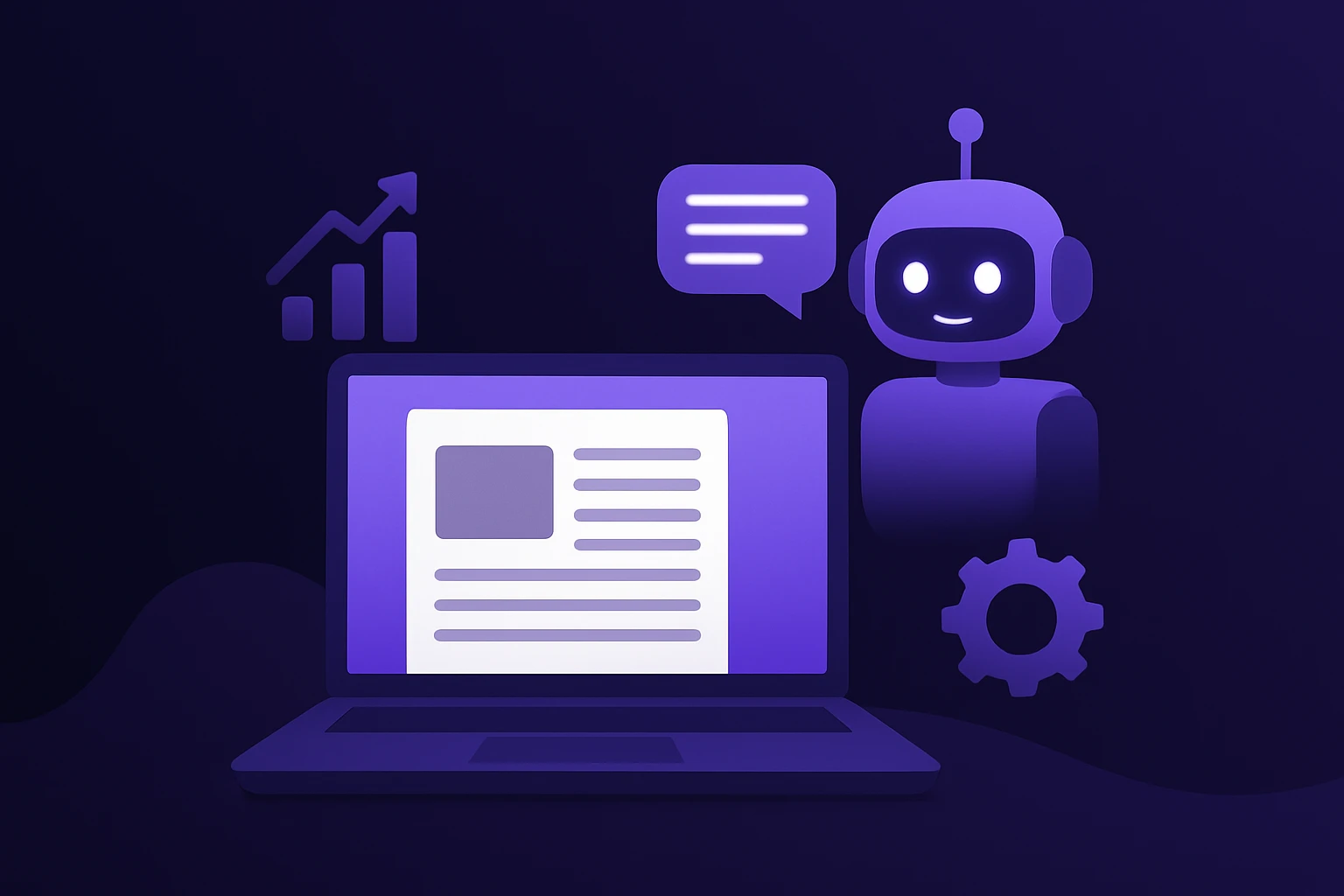
For blog publishers, the practical stack is becoming clear: research agents, drafting agents, CMS-publishing agents, and monitoring agents. A research agent can collect source material and identify topical angles. A drafting agent can turn an approved brief into structured content. A CMS agent can format the post, assign metadata, and publish it. A monitoring agent can track performance, broken links, content freshness, and distribution outcomes after publication.
This workflow model is already visible in real-world examples. Sanity has published prompt examples such as “Publish 20 imported blog posts migrated from WordPress,” showing that bulk publishing is not theoretical. Pebblous described an automated system where a single /new-post command initiates article creation and /publish regenerates RSS and sitemap. The lesson is simple: scale comes from orchestration, not from repeatedly asking one model to write another article.
How to build an agentic blog pipeline
A scalable blog pipeline begins with research and planning. A research agent can scan internal knowledge, prior posts, market news, and approved external sources to produce topic clusters, draft briefs, and recommend target keywords. This is especially relevant because a 2026 browser-agent field study from Perplexity found that Productivity & Workflow and Learning & Research together accounted for 57% of Comet Assistant queries, showing how heavily agents are already used for information work.
Next comes synthesis and drafting. An agent can convert a brief into an outline, identify missing evidence, flag unsupported claims, and draft sections according to brand rules. Because OpenAI highlights reliability and scaling as core agent product priorities, teams can increasingly design repeatable drafting processes with templates, source requirements, and editorial constraints rather than relying on ad hoc prompting.
The final steps are operational. A CMS agent can create entries, format HTML or rich text, insert internal links, populate metadata, schedule publication, and trigger downstream actions such as sitemap and RSS updates. Monitoring agents then review indexation, ranking movement, content decay, and post-publication anomalies. In this setup, humans still make key decisions, but agents remove the manual friction that slows throughput.
Distribution is changing as agents become the audience layer
Scaling production is only half the story. Distribution is also being transformed by agents. AgentMarketCap reports BrightEdge data showing AI agent web traffic reached 88% as much as human search traffic in April 2026. If that benchmark holds directionally, blog publishers are no longer writing only for human readers arriving through traditional search; they are also publishing into an ecosystem where agents retrieve, summarize, and recommend content on behalf of users.
Traffic benchmarks point to the same shift. The same report cites HUMAN Security data showing AI bot traffic grew 187% between January and December 2025, while AI agent browser traffic surged 7,851% year over year. Meanwhile, Akamai reported AI bot activity rose by 300% in 2025, with media ranking second globally at 13% of AI bot traffic. Publishers are already operating in an agent-heavy environment whether they have adapted their workflows or not.
This changes how content should be structured. Akamai distinguishes AI training crawlers from AI fetchers that retrieve content in real time to answer user queries. For blog teams, that means discoverability may depend not only on classic SEO signals but also on clarity, freshness, structured formatting, source attribution, and machine-readable organization that helps retrieval systems understand and cite content accurately.
Governance matters when output scales
As teams scale blog publishing with AI agents, governance becomes essential. A 2026 AI agent index paper highlights the growing deployment of agentic systems along with the need for technical and safety features. In publishing, that translates into practical controls: source whitelists, approval gates, logging, permissions, version history, and clear rules for what agents may publish automatically versus what must be reviewed by a human editor.
This is especially important because the line between legitimate automation and problematic traffic is becoming harder to distinguish. A March and April 2026 publishing-industry report noted that AI-driven traffic is emerging as a major internet category and that automated traffic is growing faster than human activity. When your workflow and your audience both include agents, transparency and auditability are no longer optional.
Strong governance also protects quality and brand trust. Agents should be required to cite sources, preserve editorial voice, avoid unsupported claims, and escalate uncertain outputs. The goal is not to slow the system down but to make it dependable. As OpenAI’s DevDay messaging emphasized, the industry focus is increasingly on building agents more reliably, which is exactly what high-volume publishers need.
Balancing scale with authenticity
One of the main concerns about automation is that higher output may reduce originality or brand distinctiveness. That concern is valid, but it is not a reason to avoid agentic workflows. It is a reason to design them properly. Pebblous, for example, described a system intended to publish more than 200 articles in a year while still keeping a human touch. That tension captures the real challenge: not whether to automate, but how to automate without flattening editorial identity.
The answer is to let agents handle repeatable work while humans shape judgment. Editors can define the publication’s angles, voice, standards, and priorities. Agents can execute the labor-intensive parts at speed: compiling research, preparing drafts, formatting posts, republishing updates, and managing bulk actions. This division of labor allows teams to expand coverage without turning the blog into generic output.
TechRadar’s 2026 analysis argues that agent growth is reshaping the web in real time, with AI agents increasingly crawling, scraping, synthesizing, and generating content at scale. In that environment, authenticity becomes a competitive advantage. The blogs that win will not be the ones that automate everything blindly, but the ones that combine scale, speed, and distinctive editorial judgment.
The opportunity for publishers is clear. AI agents are maturing from simple assistants into coordinated digital coworkers that can support every stage of blog production. The strongest evidence points to a workflow-based model: research agents, drafting agents, CMS agents, and monitoring agents working together with human oversight. That is the practical path to increasing output without multiplying operational complexity.
At the same time, the web itself is becoming more agent-mediated, from content creation to discovery and consumption. Publishers that move early can build systems that are faster, more structured, and better governed than manual processes alone. To scale blog publishing with AI agents successfully, the goal should not be endless automation for its own sake. It should be a resilient editorial machine that produces useful, credible, and discoverable content at volume.