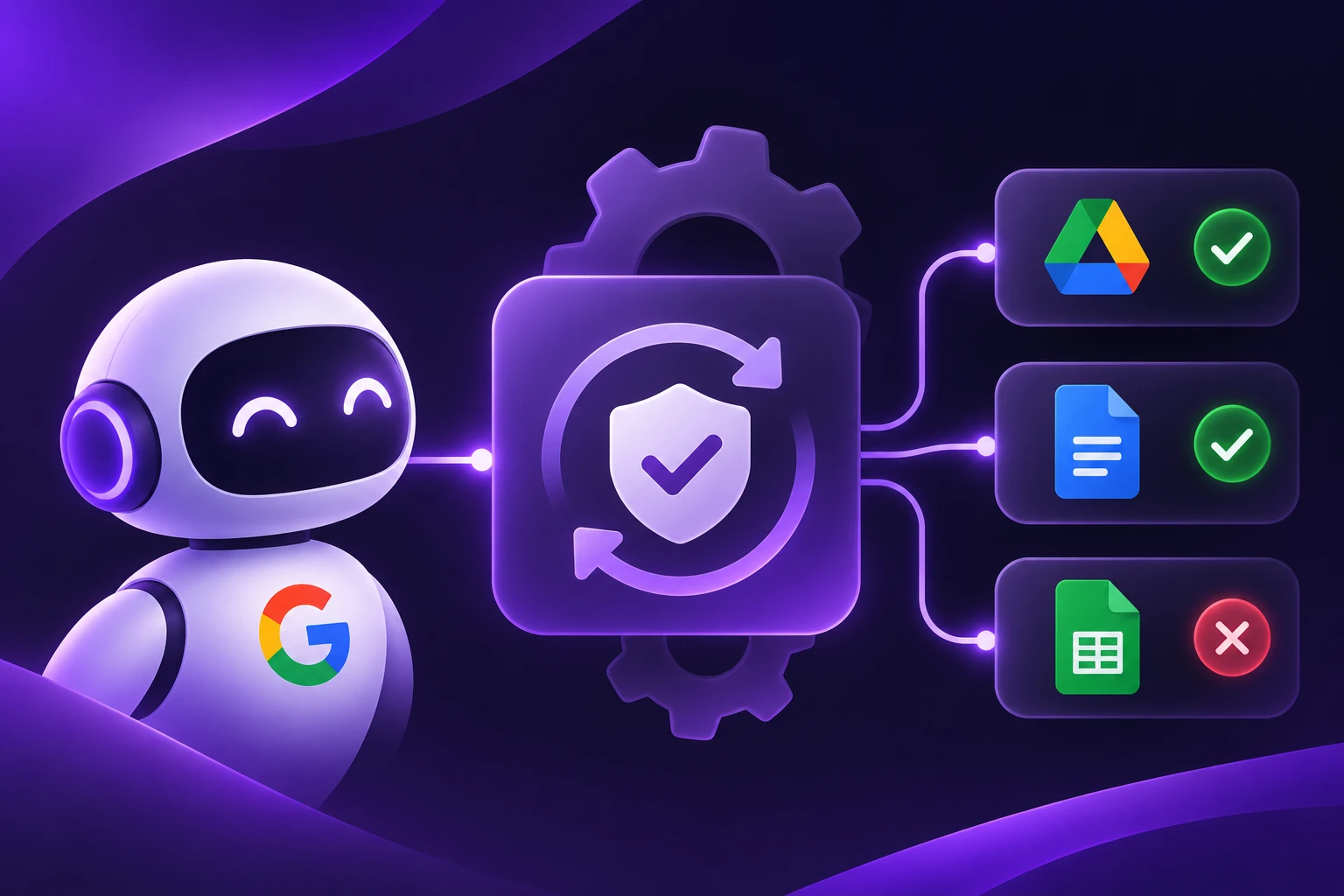
Los Angeles schools block Google's AI features on district-managed student devices and accounts, but that does not mean Google Search has already disappeared from classrooms. Los Angeles Unified School District says it had disabled Google's conversational AI Mode before Google's latest policy change, and it is now reviewing whether it can preserve search access without enabling unwanted AI tools.
The dispute matters because it connects two decisions schools may want to make separately: whether students can search the web and whether they can use generative AI. For families and educators in LAUSD, the second-largest public school district in the United States, serving roughly 378,000 students, the immediate questions are what remains available, which accounts are affected, and what happens if Google does not offer a lasting way to keep search without AI.
Why Los Angeles schools block Google's AI features
Direct answer: LAUSD has blocked Google's AI Mode and other generative AI features on district-managed student devices and profiles while it evaluates policy, safety, and instructional use. Google Search remained available in the district's latest reported account, but Google's new K-12 access policy could require administrators to enable AI-related services to retain search.
District Chief Information Officer Jack Kelanic said LAUSD had already disabled Google's AI Mode on school-issued student devices at the start of the school year. That distinction is important: the district's restriction was not simply a new response to Google's latest announcement. An existing local AI policy has collided with a change in how a major technology provider makes its services available.
The restriction also extends beyond a single chatbot. LAUSD's earlier approach used firewall and web-filtering tools to block standalone generative AI services as well as AI features embedded in Google Workspace. The district was therefore addressing both obvious AI destinations and AI functionality inside tools students might already use for schoolwork.
The central dispute is whether a school can keep ordinary web search available while declining student access to generative AI.
That is a summary of the policy conflict, not a claim that LAUSD has already removed every Google product. A district spokesperson told reporters that AI Mode, which allows students to converse with Gemini, was disabled while Google Search remained accessible at that point.
Headlines about Los Angeles blocking Google AI can obscure this separation. Blocking conversational AI, restricting embedded generative features, disabling search, and leaving Google's wider product ecosystem are different actions. The reporting supports the first two as existing restrictions and describes the latter two as possibilities under review, not completed districtwide changes.
For readers trying to understand the immediate situation, the clearest starting point is therefore the distinction between an active AI restriction and a potential search-access consequence. Treating those as the same event makes the policy look more settled than the reported facts support.
Which student devices and accounts are affected?
LAUSD's AI restrictions follow both the equipment students use and the district identity they use to sign in. School-issued laptops and tablets are covered, but taking a personal device does not necessarily place a student outside the restrictions.
- District-issued student devices: The district's generative AI blocks apply to school-issued equipment, including laptops and tablets.
- District profiles on personal devices: The restrictions also apply when students use district credentials in a district profile on personally owned equipment.
- Personal-device use: Students can still use personal devices, but signing in with district credentials brings the district's AI restrictions into scope.
This is an important practical detail for families. A student might reasonably assume that a service available on a home computer should also work when that same computer is used for school. Under the described policy, the signed-in district profile matters, not just who owns the device.
Why account context matters
Consider a student opening a browser on a personally owned laptop and signing in with a school account. Under LAUSD's stated scope, the district AI restrictions still apply to that district profile. The fact that the laptop belongs to the family does not, by itself, remove those controls.
That example explains the reported policy boundary; it is not a recommendation to switch accounts to evade it. For assigned work, students need to know which account and services their school expects them to use. A workaround that changes the account context may also change whether the student is working within the school's approved environment.
The available facts do not establish the exact experience in every browser, application, or personal account. They also do not establish a matching rule for every employee account. Families should avoid extrapolating from the student-device restrictions to all possible uses of Google products.
The useful question when access differs between devices is therefore more specific than whether Google works. It is which service is being opened, which profile is active, and whether the activity is taking place through district credentials. Those details help distinguish an intended AI block from a separate access problem that a school may need to investigate.
How Google's K-12 policy links search access to AI
Google's new K-12 policy is the immediate source of the standoff. The company said AI tools such as Gemini, Notebook, and Classroom, along with Google Search, would be turned off for student accounts unless school administrators explicitly enabled them.
Chris Phillips, Google's vice president and general manager of education, described the change as an opt-in model: access would be automatically turned off until administrators enabled it. In Google's framing, the school administrator makes an affirmative access decision rather than receiving the services automatically.
LAUSD's concern is the relationship between those choices. The district wants to restrict student-facing generative AI, but it is reviewing how to proceed if retaining Google Search means opting in to AI features it has chosen to block.
Default-off access does not settle the control question
Two separate policy questions sit inside the phrase opt-in. First, are services unavailable until an administrator acts? Second, can an administrator enable the service the school wants while continuing to disable the features it does not want?
Google's statement addresses the first question. The conflict with LAUSD centers on the second. A default-off approach can give administrators an initial approval step without necessarily giving them the lasting separation between search and AI that the district is seeking.
- Google establishes the access conditions. Student access to the listed services is off unless administrators enable it.
- LAUSD applies its local AI restrictions. Its existing policy blocks generative AI in the district-managed student environment.
- The district reviews the resulting choice. It must determine whether it can keep search while maintaining those restrictions, or whether another approach is necessary.
The reported facts do not provide a complete administrative-control map for every listed Google service. They should not be read as proof that every feature has identical settings or that every possible configuration has been exhausted. What is established is that LAUSD sees the search-access condition as serious enough to review disabling Google Search and weigh alternatives.
The decision to watch is whether Google provides a permanent way for schools to preserve search while declining the AI features at issue. An announcement about administrative choice would need to be assessed against that practical requirement, not only against whether it uses the language of consent or opt-in access.
What LAUSD's broader AI moratorium is meant to address
LAUSD's restrictions sit within a broader generative AI moratorium. Reporting described the moratorium announced in September 2026 as a temporary ban on generative AI on school-issued devices while the district evaluated policy, safety, and instructional use.
That description establishes a review process, not a finding that every AI tool is unsafe or that generative AI has no educational value. It also does not establish a permanent rejection of the technology. The stated purpose was to create space for the district to decide how it should be governed and used.
Embedded AI complicates the policy boundary
A standalone chatbot is a relatively distinct destination: a student opens a service specifically to interact with AI. Embedded AI presents a different policy problem because the feature appears inside a product that may already have a place in classroom routines.
LAUSD's use of controls against both standalone services and Google Workspace AI features reflects that distinction. The district was not treating the issue solely as access to a list of chatbot websites. It was also trying to define what functions should be available inside familiar school tools.
For administrators, this makes product names an incomplete description of policy. Approving a platform for one purpose does not answer every question about features later offered within it. A clear rule needs to distinguish the underlying classroom function from the generative capability being evaluated.
- Policy review: What uses should be permitted, restricted, or subject to additional approval?
- Safety review: What conditions would the district require before approving student use?
- Instructional review: What learning purpose would an approved feature serve?
These are decision questions consistent with the stated review areas, not a list of findings LAUSD has announced. The supplied reporting does not provide the district's completed standards, an approved tool list, or a timetable for ending the moratorium.
The distinction matters when evaluating the restriction. A temporary pause can establish a boundary while rules are developed, but the public still needs to understand what the review is intended to produce. The meaningful next stage would be an explanation of the approval criteria and permitted uses, rather than simply a broader statement for or against AI.
What losing Google Search could mean for classroom work
LAUSD has not been reported here as having completed a shutdown of Google Search. The educational planning issue is what schools would need to do if the district ultimately chose that option to maintain its AI restrictions.
The first task would be to separate the learning activity from the particular service used to carry it out. An assignment that asks students to locate sources has a different dependency from one whose instructions require a specific Google interface. Reviewing those dependencies would help schools identify what needs rewriting and what can continue with a different approved route.
Search results and generated answers serve different functions
For this dispute, the useful distinction is between locating information and interacting with a system that generates a response. LAUSD has sought to preserve the former through Google Search while blocking the conversational AI Mode. Google's access policy puts pressure on that separation.
Neither access choice replaces the need to examine evidence. Students still need to identify where information comes from, assess whether it supports a claim, and distinguish a source's statements from their own interpretation. Those learning goals can be stated independently of which search product a district approves.
If access changed, teachers could review classroom materials in several practical ways:
- Identify instructions that explicitly require Google Search rather than a general research task.
- Check that any replacement research route is available through student district accounts.
- Provide clear source requirements so students understand what evidence an assignment expects.
- Explain whether generative assistance is prohibited, allowed, or limited for that particular task.
These are preparation options, not measures the reporting says LAUSD has already implemented. They also do not establish that any alternative service would be an equivalent replacement. A different tool would need its own review rather than being assumed suitable simply because it is not Google.
There is an instructional trade-off here. Keeping an established search route may preserve familiar assignment workflows, while changing services may give the district a different set of controls. The responsible comparison would consider both access requirements and the work teachers and students would need to do differently. It should not assume that either continuity or replacement automatically resolves the underlying AI-policy question.
What alternatives LAUSD is weighing,and their limits
According to AP reporting, districts including LAUSD are considering dropping Google products entirely unless the company provides a permanent AI workaround. That is a broader possibility than disabling AI Mode, and it should be understood as an option under consideration rather than an announced completed departure.
The alternatives can be viewed as a range of decisions, from seeking narrower feature controls to reconsidering the wider product relationship. Each addresses a different level of the problem.
Preserve search with durable AI controls
The most direct resolution to the stated dispute would be a lasting arrangement that allows the district to retain Google Search while keeping the unwanted AI functionality disabled. That would address the specific separation LAUSD is seeking without requiring search access itself to become the enforcement boundary.
The word permanent is significant in the reported demand. A district evaluating a workaround would need to understand whether it is an ongoing supported configuration, what it covers, and whether future product changes could alter it. The reporting does not establish that Google has provided such a resolution.
Disable Google Search and approve another research route
LAUSD is reviewing whether to disable Google Search if the access condition stands. If it took that step, the next question would be what students should use for school research instead. The supplied facts do not identify a replacement search provider selected by the district.
Any proposed alternative should therefore be described as a candidate for evaluation, not as the district's chosen solution. Relevant questions would include student-account access, available administrative controls, the presence of embedded generative features, and suitability for assigned work.
Reconsider the wider Google relationship
Dropping Google products entirely would require a broader assessment than changing a search setting. Before making such a decision, a district would need to identify which classroom activities depend on the products under review and how those activities would continue elsewhere.
- Scope: Which services would actually be replaced?
- Continuity: How would students and staff complete affected work?
- Governance: Would the alternative offer the feature-level controls the district wants?
- Communication: How would schools explain the new expectations to families?
No supplied figures establish the cost, timing, or workload of any transition, so those consequences cannot be quantified. The grounded conclusion is narrower: LAUSD is weighing alternatives, and the seriousness of that review depends on whether Google offers an acceptable long-term separation between search and AI.
How an AI restriction differs from teaching AI literacy
Coverage of the moratorium reported surprise among some board members and parents, along with questions about how students would learn AI skills. Those concerns raise an educational issue that a technical access rule does not resolve on its own.
Blocking student use of generative AI and teaching students about generative AI are different choices. A district can restrict direct interaction with a tool while still considering how students should learn to recognize AI-generated material, question its claims, and understand rules for its use. Whether LAUSD will adopt particular lessons or supervised activities is not established by the supplied reporting.
Separate the learning objective from the access decision
A useful instructional discussion starts with what a student should be able to understand or do. Learning to evaluate an answer, disclose assistance, or trace a claim to evidence does not necessarily require the same access arrangements as unrestricted use of a conversational service.
For example, a teacher could propose a lesson in which students critique a prepared response against source material rather than log in to generate responses themselves. That is a possible instructional design, not a reported LAUSD program or a claim that it is permitted under the district's current rules. Its value as an example is to show why AI literacy and open tool access should not be treated as synonyms.
- Understanding: Can students explain what kind of assistance a tool provides?
- Verification: Can they check a claim against identifiable evidence?
- Authorship: Can they distinguish their own work from assistance they received?
- Judgment: Can they explain why a use is appropriate for one assignment but not another?
These questions offer a way to discuss educational goals without prejudging the district's approval process. They also make room for a genuine trade-off: direct use may be relevant to some learning objectives, while other objectives can be approached without giving students access to the tool under review.
The policy challenge is therefore not simply whether students encounter AI. It is how schools connect any permitted encounter,or instruction about the technology,to a clear purpose. Public communication about that distinction would help families understand what the moratorium pauses and what learning it is intended to support.
What parents, students, and educators should check now
For families, the most useful response is to establish the current rule for the account and assignment in question. The reported situation contains both existing restrictions and possible future changes, so a line alone is not enough to diagnose an access problem or decide which tool to use.
- Identify the service. Determine whether the issue concerns Google Search, AI Mode, a standalone chatbot, or an AI feature inside a classroom product.
- Check the signed-in profile. District restrictions apply to district profiles on personal devices as well as district-issued student equipment.
- Confirm the assignment's expectations. Ask which research methods and forms of assistance the teacher has authorized.
- Use the school's support route. Describe the service, device, and account involved when reporting unexpected access problems.
- Look for an explicit district update. Distinguish a review of possible changes from an announcement that access has actually changed.
Teachers can apply the same approach when preparing work. Rather than assuming that every student sees the same features available on a teacher's own account, they can check the intended student experience through the school's approved process. This is a practical verification step, not a claim that all staff and student settings currently differ.
Communication should also distinguish policy restrictions from technical faults. If an AI feature is intentionally blocked, families need an explanation of the rule and the approved way to complete the task. If an expected research service is unexpectedly unavailable, the school needs enough detail to determine what happened.
There is no need for families to infer that every existing Google-based assignment has been cancelled or that a full product migration has been decided. Neither conclusion follows from the supplied facts. The immediate priority is to follow current school instructions while watching for a clear change in access or policy.
For school leaders, the reported surprise among some parents and board members is also a reminder that technical enforcement and public understanding are separate tasks. A concise explanation of what is blocked, why it is blocked, and where students should turn for approved help would answer more practical questions than a broad statement about being for or against AI.
Why the Los Angeles,Google dispute matters beyond LAUSD
The scale of LAUSD makes the dispute nationally significant, but the governance question is not unique to Los Angeles. Other large districts, including New York City, have also limited student-facing AI tools while assessing safety and instructional use.
That does not mean those districts have identical restrictions or face the same Google access decision. It does show that LAUSD's review belongs to a wider debate about when schools should approve AI and how much control they should retain over features offered through classroom technology.
The deeper question is feature-level choice
A school may approve a service for one function without wanting every associated capability. The Los Angeles dispute tests how far that distinction can be maintained when search and generative AI are offered under connected access conditions.
For districts evaluating technology, the case suggests a concrete procurement question: can the school enable the educational function it needs while independently declining a feature still under review? That question is more precise than asking whether a product includes AI, because the district's concern is also about the controls surrounding access.
For Google, the reported policy emphasizes an administrator's affirmative decision to enable services. For LAUSD, the unresolved issue is whether that decision leaves room for its existing AI restrictions. Those positions address different aspects of control, which helps explain why describing the change as opt-in has not, by itself, settled the disagreement.
- A durable workaround would show whether search and the disputed AI features can remain meaningfully separate.
- A district access announcement would establish whether the review has become an operational change.
- Published instructional rules would clarify what uses could eventually be approved under the broader AI policy.
- A replacement decision would show whether consideration of alternatives has moved beyond contingency planning.
These are the developments that would materially change the story. Until they occur, the strongest reading of the available reporting is a continuing policy standoff: LAUSD has enforced its AI restrictions, Google has described new student-account access conditions, and the district is evaluating what those conditions mean for search and its wider use of Google products.
For now, the essential distinction is straightforward: LAUSD has blocked student-facing generative AI, including Google's AI Mode, while Google Search remained available in the latest reported district account. Disabling search or leaving Google products would be a further decision, not another name for the restriction already in place.
The useful takeaway for families and educators is to follow district guidance for current access and watch for a specific announcement about search, approved AI uses, or replacement services. The larger test is whether schools can retain a familiar research tool without surrendering their ability to decide separately when and how students use generative AI.