

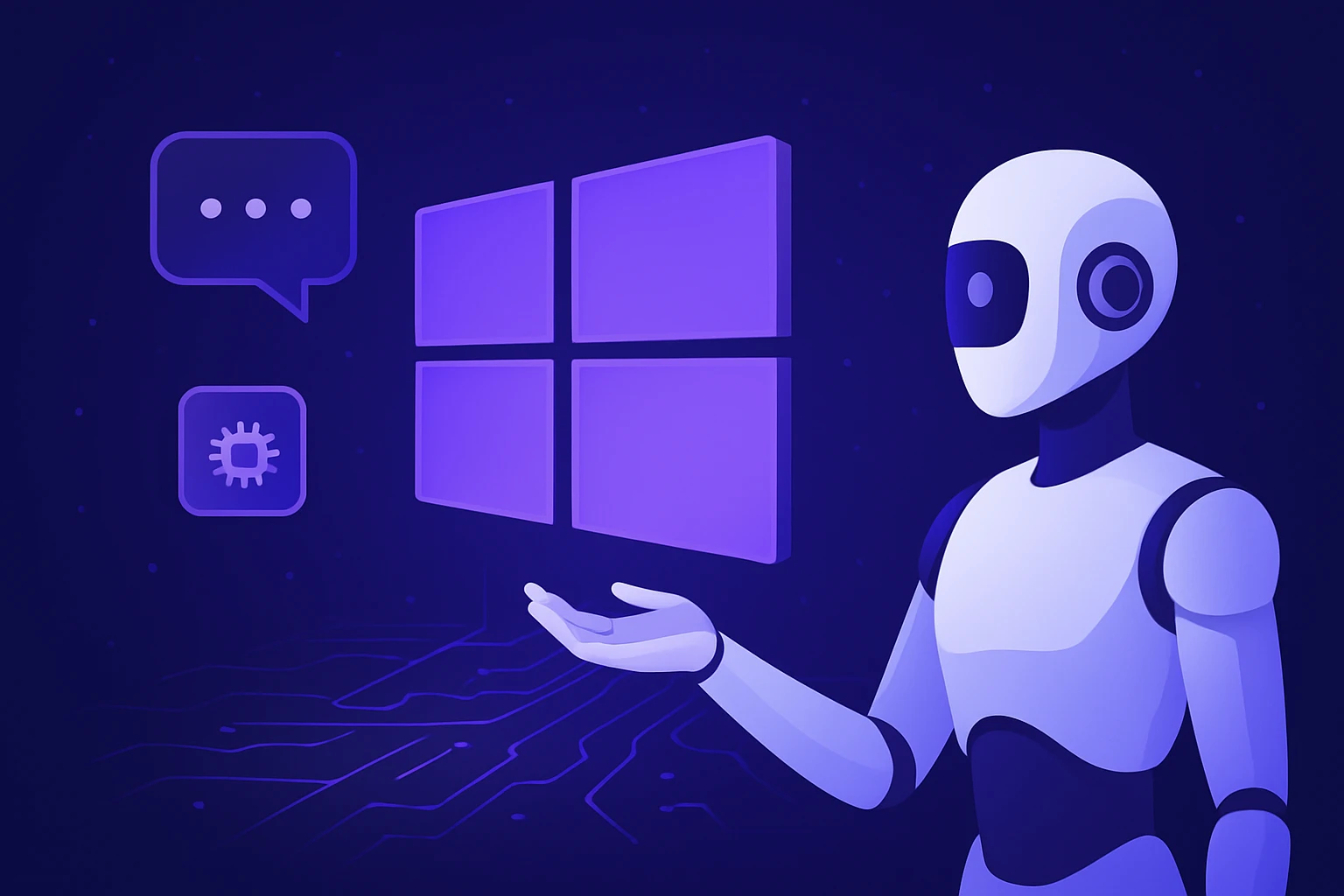
Microsoft is increasingly describing its future in terms of agents rather than traditional apps alone. That shift matters because it places Windows at the center of a new software model, one in which AI systems can reason, take actions, connect to tools, and operate across local devices and enterprise environments. Recent announcements suggest the company no longer sees Windows merely as a desktop operating system, but as a strategic layer for deploying, managing, and securing AI agents at scale.
The message has become much clearer over the past year. From Build 2025 to Build 2026, and through product updates spanning Azure, GitHub, Microsoft 365, and security services, Microsoft has been assembling what looks like a full agent stack. The result is a compelling new narrative: Windows is being reshaped into an AI agent platform, with enterprise controls, local runtimes, model access, and open standards all playing a role.
Microsoft’s New Vision for Windows
Microsoft’s June 2, 2026 messaging marked an important step in this transformation. The company said it was “bringing together Azure, GitHub, Microsoft IQ, Fabric, Foundry, Windows, Microsoft Security, and Microsoft 365 to operate as a single system you can use to deploy agents at enterprise scale.” That language is significant because it places Windows inside a unified AI operating environment rather than treating it as a separate endpoint product.
Just as important, Microsoft framed the shift as a broader business-system change. Its statement, “AI alone won’t change your business. The system running it will,” makes clear that the company wants customers to think beyond standalone copilots or chatbot features. In this view, Windows becomes part of the infrastructure that enables AI to act safely and consistently across workstations, cloud services, enterprise data, and productivity tools.
This is why the phrase AI agent platform is becoming so relevant to Windows. Microsoft is signaling that the future value of the operating system may lie in its ability to host agent runtimes, expose trusted APIs, enforce permissions, and connect local intelligence with cloud-scale orchestration. That is a much larger ambition than simply adding AI features to the desktop.
Build 2025 Laid the Foundation
While Build 2026 made the theme hard to miss, the groundwork was already visible at Build 2025. Microsoft said it was adding broad first-party support for the Model Context Protocol, or MCP, across its agent platform and frameworks, explicitly including Windows 11. This matters because MCP is emerging as an important standard for allowing AI systems to discover tools, access context, and interact more reliably with external resources.
By embracing MCP, Microsoft positioned Windows 11 within what it called the open agentic web. That suggests the company wants Windows devices to become first-class participants in a wider ecosystem of interoperable agents, tools, and services. Instead of being limited to proprietary integrations, agentic experiences on Windows may increasingly work through standard interfaces that developers can reuse across environments.
Build 2025 also aligned with Microsoft’s broader CoreAI initiative. In January 2025, the company said, “2025 will be about model-forward applications that reshape all application categories.” Seen in hindsight, that statement helps explain why Windows support for agent frameworks and protocols was so important. If applications are becoming model-forward, then the operating system must evolve to support software that is less static, more autonomous, and more dependent on AI reasoning loops.
From Operating System to Agent Runtime
Reports from Build 2026 indicate that Microsoft is now tying Windows directly to local AI agent deployment. Coverage described Windows 11 as a “trusted platform” for AI development, supported by new agent runtimes, OS-level security systems, local AI models, and Windows-native AI APIs. Together, those ingredients point to a platform that can do more than launch software; it can host and govern autonomous AI behavior.
This is an important distinction. Traditional operating systems primarily manage files, memory, hardware access, and application execution. An agent-oriented Windows would still do all that, but it would also need mechanisms for model execution, tool invocation, identity-aware permissions, task orchestration, and observability. In other words, the OS starts to act more like a control environment for intelligent systems.
The inclusion of local models is especially notable. Running AI agents partly on-device can improve latency, privacy, and resilience, particularly for enterprise and professional workloads. If Microsoft succeeds here, Windows could become the default place where personal, team, and business agents operate locally while remaining connected to Azure-based models and services when more compute or broader context is needed.
Security and Trust Are Central to the Strategy
Any serious effort to turn Windows into an agent platform depends on trust. Autonomous software can only be useful at scale if users and organizations can limit what it sees, what it does, and which systems it may touch. That is why security appears so prominently in Microsoft’s recent messaging around Windows, enterprise deployment, and AI agent management.
Independent reporting from Computex 2026 highlighted Microsoft’s partnership with NVIDIA to push Windows toward what was described as an “agentic AI OS.” The reports referenced OpenShell and new security primitives designed to restrict agent access to only the tools and data explicitly granted by the user. This fits with the idea of agents acting inside constrained permission boundaries rather than having broad, invisible access.
Those guardrails could become one of Windows’ biggest competitive strengths. Consumers and enterprises alike are unlikely to trust agents that can act unpredictably across local files, business applications, and sensitive information. By embedding security controls at the operating-system level, Microsoft can make Windows not just a place where agents run, but a place where agents can be audited, sandboxed, and governed.
A Unified Stack Across Azure, GitHub, and Microsoft 365
One reason Microsoft’s strategy looks credible is that it is not starting from scratch. Over the past year, the company has steadily assembled an agent ecosystem across Azure AI Agent Service, Azure AI Foundry, Copilot Studio, Semantic Kernel, AutoGen, and Windows 11. These pieces suggest a deliberate effort to cover the full lifecycle of agent creation, deployment, integration, and management.
That unified stack matters because agents rarely live in isolation. A useful agent may need cloud-hosted models from Azure, code and developer workflows from GitHub, user context from Microsoft 365, and secure execution on a Windows endpoint. Microsoft’s latest positioning increasingly connects those layers into a single story, with Windows functioning as both runtime surface and policy boundary.
The same logic explains why GitHub Copilot, Azure, and hardware partnerships are being discussed alongside Windows 11. Microsoft appears to be building a continuum: developers create and refine agents with its tools, enterprises deploy and govern them through its cloud systems, and Windows provides the endpoint where many of those agents interact with users, apps, and local resources. That makes Windows a practical control plane, not just a passive client.
The Enterprise Angle Is Becoming Clearer
Microsoft is also making a strong enterprise case for this direction. Windows 365 for Agents, highlighted in the company’s Ignite 2025 blog, was presented as a service that agent builders such as Manus, Fellou, GenSpark, Simular, and Tinyfish were exploring for next-generation AI solutions. That points to a future where agent workloads are delivered through managed Windows environments rather than only through browser interfaces or standalone cloud APIs.
For enterprises, this model has appeal because it aligns AI execution with familiar management and compliance structures. Organizations already know how to provision Windows environments, apply security policy, manage identities, and control device access. If agents can run within those same operational frameworks, adoption becomes less disruptive than introducing an entirely separate AI infrastructure stack.
It also reinforces Microsoft’s business-oriented message that the transformation is systemic, not cosmetic. The company is not simply adding AI buttons to Office or bundling a better assistant into Windows. Instead, it is reframing the enterprise desktop and cloud estate as an integrated environment for intelligent workers, process automation, and autonomous software services.
Autonomous Workflows Are Expanding Inside Microsoft’s Ecosystem
Recent independent reporting adds another layer to this narrative. TechCrunch and Computerworld reported that Microsoft launched Scout, an OpenClaw-inspired personal assistant, as part of a wider push toward agentic workflows across Microsoft 365. Even if these experiments are still evolving, they show Microsoft actively testing how autonomous agents can operate inside its productivity ecosystem.
This is relevant to Windows because Microsoft 365 is one of the main contexts in which enterprise users spend their day. If agents can coordinate email, documents, meetings, tasks, and internal knowledge across Microsoft 365, then Windows becomes a natural local environment for surfacing, supervising, and extending those workflows. The operating system can provide presence, notifications, app integration, permissions, and local execution where needed.
In that sense, Windows may become the front line of practical agent use. Azure may supply scale, and Microsoft 365 may supply business context, but Windows is where many users will observe agent actions, approve tasks, invoke tools, and manage trust. That gives the OS a central role in turning agentic computing from concept into daily habit.
Why This Could Reshape the Software Market
The broader industry context helps explain why Microsoft is moving so aggressively. Across its 2025 and 2026 communications, the company has repeatedly described agents as a new application pattern and as a major new software layer. If that prediction holds, then the platforms that host, secure, and connect agents will become far more important than platforms designed only for conventional application windows and user input.
That is why the evolution of Windows matters beyond Microsoft’s own product line. A successful Windows-based agent platform could influence how developers build software, how enterprises buy AI infrastructure, and how users expect computing systems to behave. Instead of launching fixed-purpose applications, people may increasingly rely on agents that can compose actions across many tools and adapt to changing goals.
A reasonable synthesis of the recent announcements and reporting is that Microsoft is evolving Windows from a consumer desktop OS into an AI agent runtime and deployment platform. That conclusion is supported by explicit Windows 11 MCP support, Build 2026 reports about local models and agent runtimes, and the company’s effort to integrate security, development, and cloud operations into a single AI system. Whether this shift happens quickly or gradually, the strategic direction is now difficult to ignore.
Microsoft’s strategy suggests that the future of Windows may be defined less by the apps it launches and more by the agents it enables. By tying together local execution, enterprise governance, cloud intelligence, and developer tooling, the company is creating the conditions for Windows to serve as both a runtime and a control layer for a new generation of intelligent software.
If that vision succeeds, Windows will not simply remain relevant in the AI era; it could become one of the central places where the AI era is operationalized. The operating system may still look familiar on the surface, but underneath, it is being redesigned for a world where autonomous agents are becoming the next major layer of computing.